Menu Close

Tag: Productivity (page 7 of 14)

Producteev Adds Google Tasks Sync, Outlook Plugin, with Native Mac, Windows, Android Apps On the Way

Producteev Adds Google Tasks Sync, Outlook Plugin, with Native Mac, Windows, Android Apps On the Way | 40Tech

Producteev won me over a while back with the smooth way they integrate into your already established workflow. The pretty helped too — pretty is a necessity for me when looking at a task list — but it was the Google Calendar integration, and the ability to interact with and create tasks from email, IM, and more that clinched it for me. As a Gmail user, I have access to a nifty widget, and Google Apps users get even tighter integration.

Enough about me and my Google services, though! We’re here to talk about you — and did you know that Producteev has just launched an Outlook plugin that let’s you single-click emails directly to tasks? And that’s not all… they’ve also announced a two-way sync with Google Tasks, and have some native apps on the way! You like? Read on for details!


Outlook Plugin

Outlook is powerful software, but it lacks mobility, which is a tough thing when you use it as your main task manager in this day and age. Producteev makes Outlook tasks portable by allowing you to take them to the cloud by way of a tightly integrated Outlook plugin. With the plugin, you can add emails to tasks in Producteev with a single click of the flag button, and with the integrated Producteev tab, you can assign it to others, add priority stars, etc. The plugin only allows you to sync with one workspace at a time, but you can choose for the sync to be two-way, Outlook to Producteev, or Producteev to Outlook only, and you can change workspaces right from Outlook, as well.

Here’s a link to the Producteev Outlook plugin screencast.


Google Tasks

I was honestly under the impression that people cared about Google Tasks about as much as they do about Buzz, Wave and Sidewiki. Or Orkut. Apparently, I was gravely mistaken, as Google is invested enough in Tasks that they went through the trouble of launching a Tasks API at Google I/O this month. Producteev was right there with them, and has created a two-way revolving door with the in-Gmail task manager.

It’s a pretty cool integration, actually. It allows you to create tasks in Google and have them sync to your Producteev workspace where they will have their own label (the list’s name) automatically assigned. It also works the other way, bringing your workspace’s tasks into Google where you can quickly check on them and interact with them without leaving your email. Yayy efficiency!

Check out the quick screencast on the integration, below:

http://www.youtube.com/watch?v=1yesX1I_KeI&feature=player_embedded

I advise you to be careful when using Google Tasks sync, however. It is, at this point, only designed to handle a connection from one Producteev workspace. If you use several workspaces concurrently, like I do in my Producteeev GTD setup, and you, say, I don’t know… connect them all… at once —  well, let’s just say you will end up with an ever-growing and duplicating list of tasks as the workspaces sync them, and then re-sync them, one after the other, after the other, after the other. *grins*  Thankfully, they all show up under one label and so were easy to delete.

If you do use multiple workspaces in your productivity setup, I recommend using only your most important workspace in Google Tasks sync. You could also use it for a priority tasks list, or to keep your Projects workspace handy at a glance.


Native Apps

Producteev hasn’t forgotten about the users out there who prefer native apps. They have had them in the works for some time now, and that awesome little tree is about to bear its fruit. A Mac app is due to hit the mainstream by the end of this month, and Windows will get a native app in mid-June. That’s straight out of the mouth (well… email) of Producteev founder Ilan Abehassera, so doubt me at your peril! Ilan also said that a fancy new Android app will be available in early June, as well.

Here’s a look at the Mac app (from the Producteev Blog):

Producteed Native App | Producteev Mac App

What do you think of Producteev’s new integrations?


GTD With 2Do and Toodledo [Reader Workflow]

GTD With 2Do and Toodledo [Reader Workflow] | 40Tech

Continuing with our Reader Workflow showcase, we’re proud to present Nina Kefer’s second post in her GTD experiments series, Beauty and Brains: Getting Things Done™ In Style. In her last article, she showed us a particularly awesome GTD setup with Awesome Note and Evernote; focused on the iPhone, overall. This time around, she delves into a mobile frontend for Toodledo. Read on for Nina’s GTD workflow with the iPhone app, 2Do.

For an additional take on Toodledo and GTD, also check out our post on Getting Things Done with Toodledo using pseudo-GTD methodologies.


Beauty & Brains: Getting Things Done™ In Style, Part 2 – 2Do

In my last article I described my GTD system for Awesome Note synced with Evernote. If you prefer a tighter sync between front and back end, however, you’ll want to give 2Do a try. 2Do is an award winning productivity app that syncs with the task management website Toodledo as well as iCal and Outlook (via a sync helper). I use a PC, so iCal is not an option and I don’t use Outlook because it doesn’t doesn’t play well with Gmail, so unfortunately I had to make do without a desktop client.

The sync with Toodledo is pretty tight, albeit with some peculiarities. 2Do’s interface is designed to look like a colourful Filofax and comes with several pre-installed “calendars” or tabs, which are basically to-dos, projects and check lists that are pulled together in the “Today” and “All” tabs. 2Do’s tabs appear in Toodledo as folders and, as with Awesome Note, they can be easily renamed or replaced to suit GTD. They can also be moved up or down and assigned custom colours – I basically think of them as dividers in a lever arch file or personal organiser.

While Toodledo supports contexts, 2Do doesn’t out of the box, but this can easily be set up by creating tags for each context and then searching for each tag using the excellent built-in search function. These searches can be saved as tabs which will then sync to Toodledo as folders. Just like “normal” tabs, they can be moved up or down to whichever position fits best with your GTD setup. Note that tags cannot be created from scratch; you first need to create a task, then you can create the tags to tag it with.


The Setup

For my to-do system I use a similar setup as in Awesome Note. Since 2Do doesn’t have a dedicated inbox, I first created a new tab called Inbox. I then created a Next Action tab as well as saved searches for all my context tags. That way I can collect all next actions in one tab, but filter them by context using the saved searches. Since these are the folders I check most often I moved them to the top of the list, so they are immediately visible on my screen when I open the app. Alternatively, you can create a dedicated “normal” tab for each context. Finally, I created Project, Someday and Reference tabs and moved all tabs in an order that suited me best. I then manually arranged the corresponding folders in Toodledo in the same order:

  • Inbox
  • @PC
  • @Contact
  • @Errands
  • @Home
  • @Waiting (these appear as tags in Toodledo)
  • Next Action
  • Projects
  • Someday
  • Reference

Setup GTD in 2Do for iPhone | 40Tech


Using 2Do

2Do offers an almost bewildering array of features, but they are elegantly tucked away in hidden menus, so the interface never looks cluttered. When creating your tasks you have the choice between three different types – to-do, checklist and project – that can be assigned six different actions: call, SMS, email, browse, visit and Google. Call, SMS, email and visit actions can be linked to the contacts in the iPhone’s address book and a tap on a task containing such an action will bring up the contact’s phone number or email address or show the postal address in Google maps. You can then call, text or email them directly from within the app.

A long tap on a task brings up a menu that shows what you can do with that particular task: mark as done, defer to another day, copy, share (via email, SMS or Twitter), delete, add note, take or attach a photo, record and attach an audio file or assign a due date and alarm. There is a choice between email alerts and local alerts, i.e. a notification on the phone lock screen that works even if data roaming is disabled or the phone is in airplane mode. For local alerts, you can choose between receiving a push message only or a message plus sound, with a choice of different alarm sounds. A red badge on the app icon shows how many to-dos are due or overdue and within the app overdue tasks appear in red font instead of black.

2Do uses two types of tags – word tags and people tags, the latter linked to contacts in the iPhone’s phone book – which make tasks easily traceable via the search function. You can also search by key word and date range, and searches you do frequently can again be saved as new calendar tabs, so in the future you only have to tap on the tab to bring up a search result.

Tasks can be sorted by status, priority (none, low, medium, high, star), due date, note, URL, alphabetical or manually. As in Awesome Note, you can sort each folder in a different way. The Today tab shows all tasks due today and additionally there is a focus button that can filter out to-dos that don’t fulfil certain requirements, e.g. due date or level of priority. Individual tasks can be moved from one tab to another with a few quick taps. Switching to landscape view in any tab brings up a calendar showing all tasks that are due in the current month. Finally, there is a nearby tab that alerts you when you approach a location connected with your task, but I don’t use it since it uses GPS and therefore guzzles battery.

2Do for iPhone, iPad, iOS | Task Management App


Tasks, Subtasks, and Sync with Toodledo

I Get Things Done in 2Do in pretty much the same way as in Awesome Note: my Inbox and Next Action (and context) tabs are reviewed daily and Project tab weekly. As with Evernote, you send emails to Toodledo to create a task; you can specify folder, priority, due date and time, tag, repeat, and attach the body of the email as a note.

2Do supports subtasks, so there is no need for workaround like there is in Awesome Note. Each subtask can be given its own tag, due date, alarm, action and attachment and can be moved out of the project and into the appropriate Next Action folder, right from within the main task menu (parent and subtask can’t be in different folders). Alternatively, if you have created contexts tabs from saved searches, adding the appropriate context tag (@PC, @Contact, @Errands and so on) will make the subtask appear in that tab, with the project and folder name still visible. Finally, if you assign a due date, the task will eventually pop up in the Today tab. However, be aware that subtasks are a premium feature in Toodledo and in order for them to sync between 2Do and Toodledo together with their parent task you need a (paid) Pro account. In free accounts, subtasks sync separately from the parent task.

Tags, due dates and notes sync to Toodledo, but photos, location maps and audio files remain locally in 2Do as Toodledo only supports notes. However, this has the advantage that these files are available for offline use on the iPhone.


There is a reason why 2Do was voted Best iPhone Productivity app: in combination with Toodledo it offers pretty much everything one could wish for, except the option to sync your tasks with the iPhone calendar. It is quick and easy enough that you barely have to use the web, yet the sync with Toodledo is tight enough to be able to use both apps more or less interchangeably. Don’t be put off by Toodledo’s less than slick appearance either. It is a powerful and highly customisable task manager and there are a number of Stylish and Greasemonkey themes to pretty it up.

What are your thoughts on GTD in 2Do and Toodledo?

Nina lives in the UK and works in Financial Services. A frequent international traveller, she has extensive experience of managing life on the go. A trip to Japan opened her eyes to the possibilities of mobile phone technology and she has been attempting to achieve a similar level of connectivity ever since. This is her first technology article.

Up Next: Part 3 – Springpad


GTD On the Go With Awesome Note and Evernote [Reader Workflow]

Mobile GTD With Awesome Note and Evernote | 40Tech

40Tech has a serious interest in productivity technology, especially as related to GTD (Getting Things Done). We love talking about workflows with our readers, sharing our own techniques as well as learning how you use technology to keep your life on track. As we’ve come to expect, grown-up geeks are fonts of information, and you’ve inspired us to invite you to post your genius here on 40Tech. The first to step up was Chase Mann with his combination of OneNote, Evernote, and Outlook for GTD, and now we are pleased to bring you the first of three posts by Nina Kefer. Nina is often mobile, and has put together three systems that she has tested extensively, using some of the prettier iPhone and web apps out there as her GTD hub.

First up: GTD in Awesome Note with a side of Evernote!


Beauty and Brains: Getting Things Done™ In Style

I have always been a firm believer in the principle of “Form Follows Function”. However, I do not believe that “Ornament is Crime”, as is often extrapolated by proponents of FFF. As long as eye candy isn’t at the expense of functionality I can’t see anything wrong with it. On the contrary, it actually helps me to Get Things Done because a pretty user interface makes me want to look at my to-dos and makes taking care of them fun. If my to-dos look bland or, God forbid, ugly, I avoid looking at them until I forget that they even exist. Thus began my quest to find a to-do system that is as beautiful as it is powerful. As a frequent international traveller, I often rely on my smartphone to keep my life organised, so I needed a system that was built around an iPhone app that stays in sync with the web and/or desktop of my netbook.


Part 1: Awesome Note

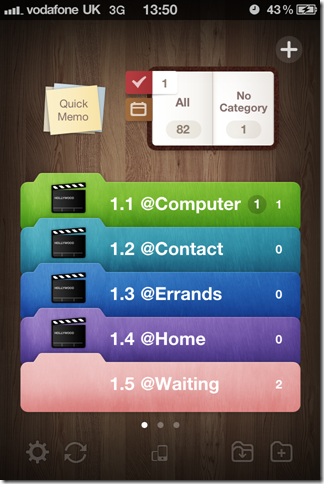
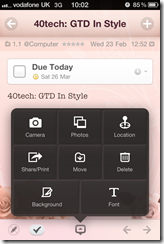
The first app I explored was Awesome Note, a note-taking-cum-to-do app that syncs with Evernote and Google docs. Notes created with Awesome Note are designed to look like real life paper notes that are kept in colourful manila folders. By default, the app randomly assigns one of fifteen available background patterns and a default font to each new note, but backgrounds and fonts are customisable, as are the colour, icon and default theme of each folder. You are limited to five folders per screen, but you can create as many folders as you like, arrange them in whatever order suits you best and then simply swipe through them from screen to screen. It’s a pity that GTD doesn’t offer more opportunities to sample the neat animation, like “turning pages” while browsing from note to note within a folder.

Being an Evernote front-end, Awesome Note’s functions, are very flexible. Every note can be transformed into a to-do, a check list, a calendar item, a page in a diary or photo album, or a birthday or anniversary reminder, simply by changing the view or type of note or by assigning a due date. You can also tag your notes and to-dos and use the built-in search function to look up tags or keywords. To help you keep on top of all the notes inside your folders, there’s a little notebook at the top of each screen that shows how many notes there are in total, how many to-dos are due today and if there are any unassigned notes waiting to be processed. Next to it, there’s a quick memo pad where you can jot down ideas, via keyboard or handwriting input, or draw a sketch. Lastly, you can share your notes and to-dos via SMS or email, send them to a compatible printer or lock your folders with a passcode. This may sound a bit overwhelming, but everything can be done with just a few quick taps.
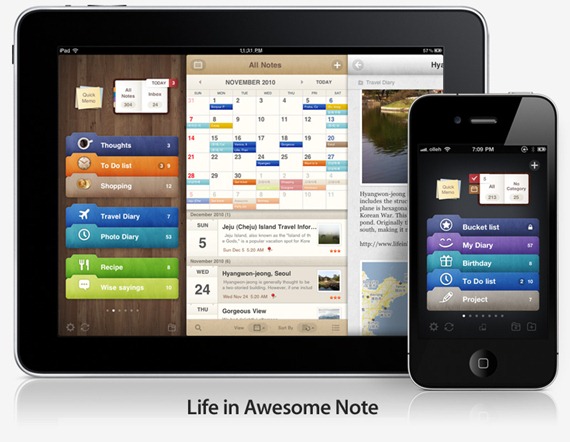
Awesome Note by Bridworks - Brilliant Idea

GTD Setup in Awesome Note

Awesome Note comes with pre-installed folders, but they can easily be renamed or replaced and new ones can be created as necessary. For my GTD setup I created ten folders, five for each screen. Since the sync of tags between Awesome Note and Evernote is limited (more on that in a moment), I combined Next Action and Context to create five Action folders that I review daily. I placed those on the first screen, so I can see them as soon as I open the app:

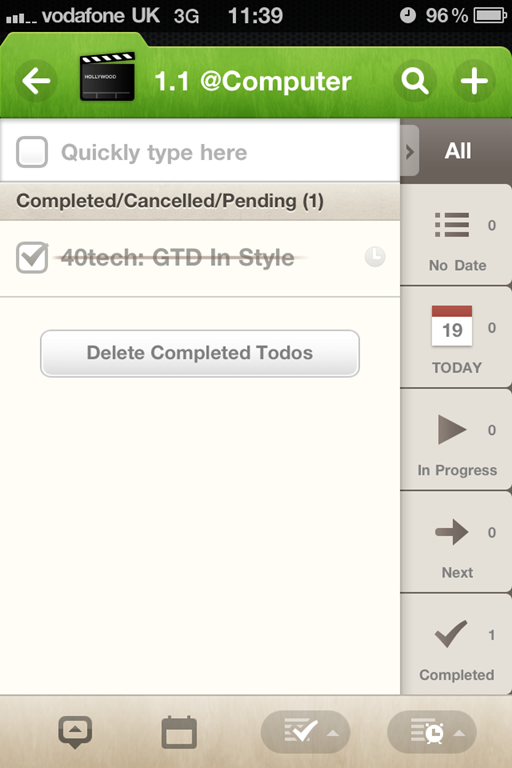
  • 1.1 @Computer
  • 1.2 @Contact
  • 1.3 @Errands
  • 1.4 @Home
  • 1.5 @Waiting

On the second screen I placed the folders I review weekly or less often:

  • 2.1 Projects
  • 2.2 Someday
  • 2.3 Goals
  • 2.4 Reference
  • 2.5 Wishlist

GTD in Awesome Note with Evernote | 40Tech

Working With Evernote

As my back-end I chose Evernote because it has both web and desktop versions and is generally more versatile than Google docs. Sync between the apps is speedy, but due to their different functionalities not really tight enough to use phone, web and desktop interchangeably. For example, Awesome Note’s folders appear in Evernote as notebooks that are easily identifiable by the prefix [aNote], but while Awesome Note allows you to arrange the folders in whatever order you want, Evernote automatically puts the notebooks in alphabetical order.

You can attach up to nine pictures to a note, but they will only sync from Awesome Note to Evernote, not vice versa, and due dates, status, font and background formatting don’t sync at all.

Finally, although both apps use tags, tags added in Evernote don’t sync to Awesome Note and tags added in Awesome Note are merely included as a footnote in Evernote. Fortunately, the powerful Evernote search finds them there, so there’s no need to double-tag. Since I do most of my GTD in Awesome Note and use Evernote web and desktop only for convenient text entry and backup, none of the above was a deal breaker for me. I just numbered my folders so they would appear in the same order on all three platforms and didn’t worry too much about the order of the notes inside.


The “No Category” Inbox

The “No Category” folder at the top of the screen is my inbox where I collect emails, tasks and ideas that come to me during the day, things that I need to buy or adverts I see on my way to work and want to follow up later. This is easy since notes that aren’t assigned to a specific folder automatically get dumped in there, no matter what screen you are in when the note is created.

Emails and URLs can be copied/pasted into the body of a note, photos can be attached from the camera roll or taken from within the app, and Google maps can be added. Alternatively, you can forward emails to Evernote and then sync with Awesome Note. Making a note read-only makes URLs, email addresses and phone numbers clickable, but unfortunately there is no option to link notes to contacts in the iPhone’s address book, so they have to be copied over manually. Quick memos that are saved as notes also end up in “No Category” (whatever you scribble down on the memo pad stays there until you either save or clear it). These are great for basic drawing. For example, you can ask someone how to get from A to B and then take the sketch with you or email it to a friend.

I review my inbox daily and process its contents according to David Allen’s GTD methodology:

  • If a task takes less than 2 minutes, I do it right away
  • If it takes longer or I can’t do it where I am I move it to the appropriate Next Action folder
  • If it takes more than two steps to complete I move it to Projects and create a to-do for the Next Action in the appropriate folder

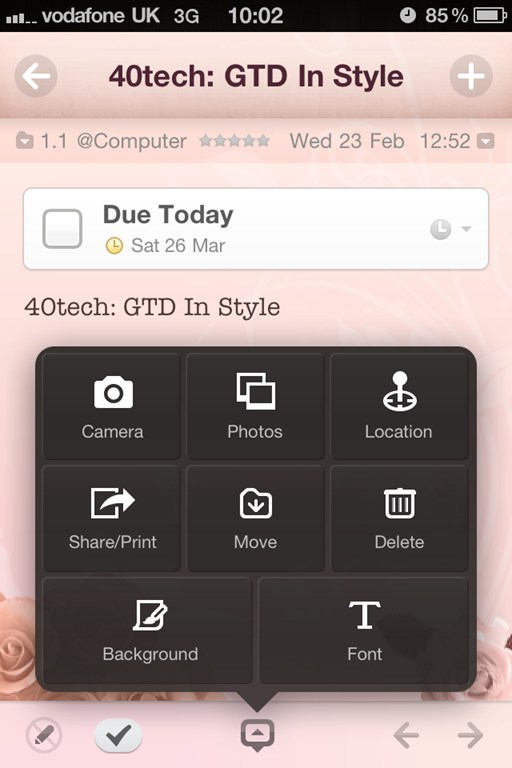
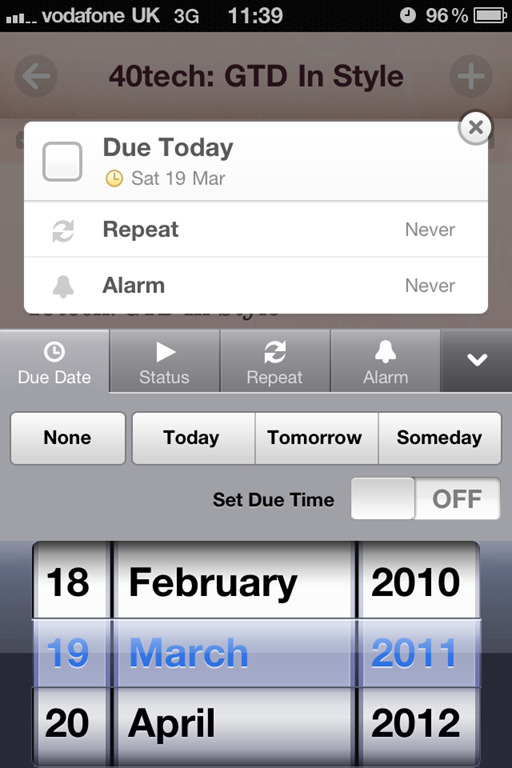
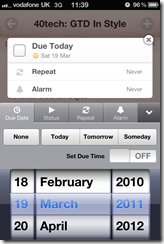
Time sensitive to-dos can be assigned alarms. Awesome Notes uses local alarms, so you will be reminded even if data roaming is disabled or the phone is in airplane mode. If a task should be delegated to someone else it goes into @Waiting with a review date to remind me to check up on and, if necessary, chase the person I have delegated the task to. Lastly, things I may want to do at some point in the future are parked in Someday and anything that doesn’t require action is either archived in Reference or deleted. If a note is moved into one of the Next Action folders it is converted to a to-do and, if possible, assigned a due date. Additionally, while Awesome Note doesn’t sync with any third party calendar, every folder, including “All”, has a calendar view that displays the to-dos within that folder, marked with the folder’s colour.
GTD in Awesome Note | 40Tech GTD in Awesome Note To Do Alarm | 40Tech Awesome Note GTD with Evernote Sync | 40Tech

Next Actions

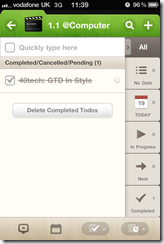
Next Actions that have been assigned a due date pop up automatically as they become due. A red badge on the app icon shows how many to-dos are due or overdue; within the app this is shown next to the red tick box at the top of the screen. Additionally, I check the Next Action folders whenever I have a spare moment. For example, when I sit down at my PC I check if there’s anything else I could do while I’m at it.

In order to make my tags more prominent in Evernote, I start the title of a to-do that I want to be searchable with the appropriate place, person or project name. This has the added benefit of being able to search tasks alphabetically in Awesome Note. Usually I sort by due date, but if I’m going to contact person ABC I can alpha-sort the to-dos in my @Contact folder to make sure I cover everything “tagged” ABC. One tag per to-do is usually enough for me – a place tag for to-dos in @Errands, a person tag for @Contact, a project tag for @Computer and so on – and it only takes two taps to sort. Awesome Note does have a search function for both tags and keywords, but no saved searches, so this doubles as a quick-and-dirty search.

The project folder is reviewed weekly, or more often if I have extra time. Awesome Note doesn’t support sub-tasks or checklists, so I list the sub-tasks of each project in the body of the parent note, e.g. Project XYZ, and then cut/paste them into individual to-dos as I work through that project. I do the same for checklists or shopping lists. Alternatively, if you want to be able to check off each item individually, you can make a dedicated folder and create a to-do for each item.


Awesome Note may have been created primarily as a note taking app, but its to-do capabilities are powerful and lend themselves well to GTD. The limited sync with Evernote forces me to keep my setup simple and fuss-free and the cheerful design makes Getting Things Done fun. I just wish that tags would sync properly with Evernote, as they do with Egretlist, and that tasks would sync with the iPhone calendar.

Let me know what you think of Awesome Note’s GTD capabilities in the comments!

Nina lives in the UK and works in Financial Services. A frequent international traveller, she has extensive experience of managing life on the go. A trip to Japan opened her eyes to the possibilities of mobile phone technology and she has been attempting to achieve a similar level of connectivity ever since. This is her first technology article.

Nina’s next iPhone GTD setup: GTD with 2Do and Toodledo.

Simplify Your Desktop for Peaceful Productivity

image

This post continues our Personalize Your Windows 7 Experience series, but much of what’s in here can be applied to any PC operating system.

Lately, I’ve been upping my productivity game. I love GTD, and I’ve been pretty successful at making tech like Evernote, Springpad, and Producteev work for me, but I still find that I have a tendency to get bogged down by clutter and distraction. A cluttered desktop doesn’t support a creative or efficient mindset very well, so I spent a little time sorting hiding the clutter with a tool Evan introduced to me called Fences. That helped, but something was missing — and I had absolutely no idea what that was. I tweaked, I fiddled, and messed about with different settings, but nothing seemed ring that proverbial gong for me. Nothing, that is, until I discovered Minimal Wall.

Minimal Wall is the ultimate place to begin simplifying your desktop experience. It’s  more than just a collection of minimalist wallpapers, though. They actually help you to get set up for the optimal desktop in just a few steps. You start out by losing the clutter and icons on your desktop, and you end by choosing a very cool background, but the most intriguing thing about their set up process is the Grid Wallpaper.

Minimal Wall | Simplify Your Desktop

The Grid Wallpaper uses simple graphic design principles to help you set up your windows for a better — and uncluttered — user experience. All you do is set the Grid as your desktop background, and then align your most commonly used windows to the yellow borders. When I first did it, I wasn’t quite sure what to expect, but I was surprised at how looking at my new desktop made me feel. It resonated with me. I was more relaxed, and I found it much easier to focus, even with several windows open at once.

After your windows are aligned, start looking at Minimal Wall’s wallpapers. I have no doubt that you’ll find them very easy on the eyes. I chose some of the Mindful Words backgrounds; nice reminders to move on to my next action, and keep focused. I even created one of my own in Photoshop — my little girl’s name –using their work as a base. It reminds me why I am sitting at the computer in the first place, and why I need to get off it again as soon as I can.

Lifehacker has a great post featuring a Minimal Wall based desktop, combined with Rainmeter, Launchy, and Rocketdock with some nice icons. Personally, I find Rainmeter to be annoying to set up and modify, so I won’t put you all through that. I did use some of the other ideas, however, such as installing Launchy (which I find I rarely use) and Rocketdock. Rocketdock, especially with the nice iconset, provides an easy to look at quick-launch that fits the theme. I won’t go to far into customizing Rocketdock here, but if you try it out and have trouble getting it to do what you want, hit me up in the comments and I’ll do my best to help you out.

So here’s the process so far:

  • I gathered all of my clutter into Fences — then I double-clicked the desktop to make the Fences hide themselves. Another double-click brings them back when you need them.
  • I used the Grid Wallpaper to line up and size my windows (and the Fences as well).
  • I selected the four wallpapers I wanted to use and put them in a folder to create a desktop slideshow (go to Control Panel, choose “Change desktop background” under Appearance and Personalization, then browse to the folder and select the images, configuring how they should change — I shuffle them every hour).
  • I installed and configured RocketDock with the new icons (add the folder of new icons into the Icons folder in Program Files (x86), then right-click on the dock and choose Icon Settings, then the icon set).

I also moved my Windows taskbar to the top of the screen and set it to auto-hide. I had originally used a tool called Taskbar Eliminator to make the taskbar vanish altogether, but I found that it was unreliable, and discovered that — since I was now rarely working in full screen — having the taskbar hidden at the top was actually quite useful for quick access to its functions.

Finally, I right clicked on the desktop and went to Personalize and saved my wallpapers as a custom theme. Doing this makes it so you can reclaim your desktop slideshow with a click, should you change it to something else and find you want it back again. To round everything out, I changed my logon screen to match the theme. Here’s how you do that:

Here’s a Few Shots of the End Result

wall-actionwall-focuswall-windowswall-windows-2wall-fences

Since adopting this new look and feel for my desktop and workflow, I’ve found that I’m more focused, productive, and generally more relaxed while I work. The basic setup took me less than a half-hour to implement, and it’s paid that time back in spades. Hell, I was so inspired that I added a customized version of the wallpapers to my iPad, too, and then hunted down and killed my next big PC distraction: keeping Gmail open in my browser while I work. If you want a little more peace and productivity while you’re sitting in front of the multi-task machine, give this a try — I sincerely hope it helps you as much as it has me!

Let me know your thoughts in the comments!


Reader Workflow in Action: GTD for Freelancers & Managing Multiple Projects

image

We like useful tech here at 40Tech, and spend a fair amount of time talking about productivity related apps. We’ve written more than a few posts talking about ways we’ve used tech to make our busy lives a little more sane, and a little while back, we asked people to show us their own workflows. We wanted to see how our readers integrate tech into their daily lives to keep them productive. We received some comments on the post, some notes on Twitter and Facebook, and even had a few email conversations with folks, and have decided to feature a couple of the more involved methods.

Today’s feature, by freelance graphics and web designer Chase Mann, involves a GTD process that includes Evernote, Outlook, Microsoft’s OneNote, and a few other choice bits of technology:


Getting Things Done (GTD) with Evernote, Outlook and OneNote

I’m a freelance graphics & web designer that uses a tablet pc. In short, these are the tools that I’ve found work best for me:

  • Moleskin notebook & pen, Smartphone with Evernote app.
  • Dropbox to automatically sync all client files and research folders.
  • Outlook for Contacts, Calendar & Tasks. (connected with Gmail).
  • OneNote as my written-note capture and Working space (on my tablet-pc) with a GTD Notebook for current Projects.
  • Evernote as my magic, portable filing cabinet & reference library.

Reference Material:

I then tweaked all these programs and setups to better fit my workflow needs.


The GTD Workflow

I begin my GTD workflow by keeping my Moleskin notebook and Android phone as my immediate capture devices, which I then process into my Evernote Inbox notebook. Because I have design software on both my desktop and my tablet pc, and I’m constantly making changes to client files and gathering research resources, I use Dropbox to have the most updated client files and research folders automatically synced between all of my devices.

My projects tend to be mostly digital so I rely heavily on email communications (and some telephone conversations), but I tell all my clients that I prefer email so we both have documented project conversations. Outlook has quickly become my main communications & scheduling hub. Once I am referred a potential client, I setup a meeting to discuss project needs via whatever medium they prefer. I always take notes during the conversation and then email a copy to the client as my first follow-up step. If the client chooses me for the project, then I make new notebooks in both Evernote and OneNote specifically for that client and that project.

As I have time to sort through my inboxes, I’m able to organize and set tasks up as Projects. All Projects get their own notebook created in OneNote. I also attach that notebook to all possible related contacts in Outlook.

Why the heck would I use Outlook? I love the integration of Outlook and OneNote (2010 versions). I like being able to take an email about a client meeting and actually turn it into a task AND an appointment on my Calendar. I love being able to set reminders on tasks and calendar items too. It’s my tickler system. Easy.

As I process emails, they either get turned into scheduled tasks, flagged with a reminder tickler, sent to Evernote as reference, or sent to OneNote for current working projects. A major benefit of sending an email from Outlook to OneNote is that any attachments on the email show up as attached files in OneNote. How cool is that?!


Using Evernote

From the beginning, I had decided that Evernote would be my magical, brain-dump, inbox, filing cabinet. My very own research and records department that I can conveniently carry around in my pocket and access via a variety of mobile options. I setup Evernote using Bobby’s article with some tweaks to better suit my workflow.

Since Evernote came out with sub-notebooks, I find it easier to use those on my Android phone. I created a “Clients” notebook with sub-notebooks for each client by name. “Inbox” is my default notebook and “References” notebook, because I like moving items out of the Inbox notebook as part of my review process. I also created a “Coffee” notebook because I’m heavily involved in the coffee industry.

For all of my own personal projects, I create “@Project-name” tags to easily find them and I created a “!clients” tag for quickly marking items for later processing into the actual client’s sub-notebook.  Since I really don’t use Evernote for my GTD (I prefer Outlook and OneNote for that), the only other tags I used were Bobby’s suggestion of Reference Materials, with a “folder” tag for each letter of the alphabet … which I further break down into actual tags. So A, would also have Apple, Art, Amphibians, etcetera … whatever tags make the most sense to me when I capture the item.

I do most of my project research via the internet and send pages, selections and images to Evernote with the !clients tag into my Inbox notebook for later sorting. Next I sort through my research materials and send selected items over to the project’s notebook in OneNote and create a mood-board page so I can mix and match items organically and scribble notes wherever I feel like it.


OneNote

OneNote is my working desktop so I try to keep it tidy by not using it as a reference tool, even though I could. The reason I prefer OneNote over Evernote for projects is because with a tablet PC I have the freedom to scribble hand-written notes anywhere I like in OneNote — then I can right click them and convert them into typed text. I also keep a section called “Scribbles” in each Client’s section group so that I can scribble notes and ideas as they hit me, then I convert them into tasks or reference material during my daily review of projects. I try my best to stay organized as I go so I have less processing to do during reviews.

One extra thing I did with OneNote was to setup a Clients Notebook where I created a section-group for each client with a Projects section that has pages and sub-pages for each active project I have with that client. I have an All Projects section in my GTD Notebook that lists all my currently active projects which has a wiki-style link to the Client’s section-group, and the specific Projects section for that client (and vice versa). This way I’m able to move around quickly within OneNote. I have To Do lists in each Client section-group and have those wiki-linked to a main To Do list in my GTD Notebook. I also set up an Archives section in each of the Client’s section-groups where I send the individual projects when they are totally complete. This way I only have current working projects in the active Projects section of both my GTD Notebook and my Clients Notebook.

Another reason I prefer to keep Evernote for reference and OneNote as my Projects organizer is so I can use the power of tags in each program respectively. I like being able to list all my tags across all notebooks in OneNote and know that they are project-related.

When I’m looking for a reference item, I know to just search by tags in Evernote and copy/paste only the necessary bits I need (instead of entire articles or web pages) over into OneNote.


Reviewing

I do a daily review each morning so I can make new daily lists, and I do a Sunday morning weekly review. I do mine in the mornings so that I’ve not got a lot on my mind when I’m trying to go to sleep at night.

So that’s my current workflow – thought it is still developing and being refined. I’m curious if someone has done something similar, but with Google apps or other free apps?


Chase Mann is the owner of Aim It Media, a creative design and marketing company for entrepreneurs and small businesses. You can connect with him via his many comments on 40Tech, or catch him on Twitter as @AimItMedia, @MyCoffeePro, or @Creativarty