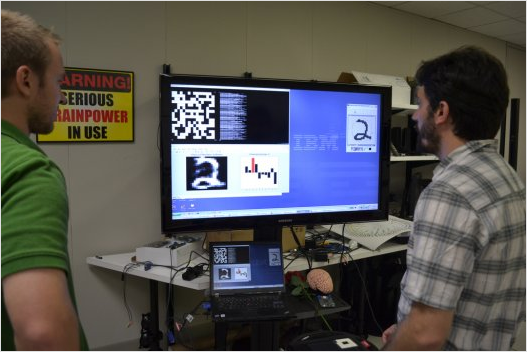
Remember IBM? They may not be the premier computer manufacturer they once were, but the world’s oldest computer company is still skating on the cutting edge of technology. Their latest achievement? Two DARPA SyNAPSE (Systems of Neuromorphic Adaptive Plastic Scalable Electronics) funded prototype chips that can learn and remember in a way that “begins to rival the brain’s function, power, and speed.”
Can you say Skynet?
Ok, so we’re nowhere near AI-driven world takeover, but thinking computer chips that require very little in the way of size or power to operate is definitely a step in the bright direction. What these chips really represent is a shift in the way computers process information. They move away from the traditional Von Neumann architecture that relies on processing and memory to work separate to each other. Both chips have 256 neurons, with one chip containing the programmable synapses, and the other, learning synapses that can “remember and learn from their own actions.”
IBM’s end goal is to create a shoebox-sized chip/brain that has some 10 billion neurons and 100 trillion synapses that runs on 1 kilowatt-hour of power (the human brain has 150 trillion synapses and needs about 20 watts). Eventually, they are looking to create cognitive computers that can take detailed input from multiple sources at the same time, process it and make a decision based on its own experiences as well as its programming. IBM has just finished phases 0 and 1 of the project and have already been experimenting with machine vision, associative memory, patterns recognition, navigation, and more.
Like I said, don’t take a hammer to your computer and networked devices just yet — the fun’s only just beginning. These brain chips could herald a whole new age of computing.
Over on Google+, Kevin Rose recently asked his users a simple question: what was your first computer? Since the 40Tech demographics might skew a bit older than the San Francisco startup scene, that got me wondering how the 40Tech community would answer that same question. So I’ll ask it – what was your first computer?
Today, 40Tech is pleased to present a guest post by Kyle from InkCartridges.
I have worked in the printing industry for a while now, and I could probably say that it’s not exactly an exiting field of technology… but I’d be wrong! The last couple of months I’ve discovered so many amazing inventions and creations, all printer related, that I could never have even imagined. It just goes to show that even the most boring of things can be fun at times if you look hard enough. Lets have a look at just a few amazing printer inventions and gadgets…
I just spent the last few days rearranging my house, moving my mother, and then rearranging and cleaning my house some more. Naturally, that got me thinking about robots.
As it turns out, there are no robots out there that can do all of those things for us yet (boooo!), but there have been some great strides in the general direction, as well as in artificial intelligence in general. Check out some of the videos that I found:
This video is in Japanese, but it is a nice showcase of Toshiba’s ApriPoco and Tokyo University’s robots. These are robots that can control your electronics with IR and voice commands, help you do the dishes, and help you get around. I’m not sure as to how capable these robots are of actually learning beyond what they are specifically programmed for, however. They could be more complicated software than actual AI — but they are still cool. And cute. It’s always good to be cute.
Domo
Domo is a robot out of MIT (Massachusetts Institute of Technology), created by Aaron Edsinger, and shows off some impressive voice recognition and visual tracking. It is only a torso, and is definitely a work in progress, but the most important thing about Domo is that it learns. Big, friendly eyes and sensors that respond to human touch aside, this robot can figure out the best place to grab something before it picks it up — which may sound easy, but is incredibly hard to program. And yes, it is named after the Styx song. Hit the link to enjoy that little piece of the 80’s for yourself.
STAIR, Cool Helicopter Tricks & the Future of Robotics
STAIR is short for STanford Artificial Intelligence Robot, created by roboticist Andrew Ng, who, after several years of trying to improve on robot AI through increasingly complex programming and mathematics, has now changed his angle to a more simplified approach. Apparently, the brain runs on a very simple learning program that neuroscience has proven to be the same for each of our senses. Ng and his team have put that concept to good use and have had some impressive results. STAIR is able to differentiate between different objects, find what it is looking for and pick it up, without a 3D model or any specific programming — all it needs is a little one on one instruction. Once it has been shown how, STAIR can figure out the rest on its own, even though every object is not exactly the same.
Before focusing on the machine learning aspects of STAIR, Ng’s robot was about 88% reliable in finding and picking up objects. Since the shift in thinking, however, accuracy has jumped up to 97% — which is pretty amazing! Ng and his team also used this technology on a small helicopter, making it autonomous. This helicopter was not only able fly itself, but, after observing a human doing the same, it taught itself how to do some crazy stunts as well, like flying upside down and other aerial acrobatics.
There is no YouTube video for STAIR, but you can find links to videos on this page. If you want to see the very cool helicopter, see the video below. The one following that is a presentation (about 16 minutes) by Andrew Ng talking about the future of robotics and showing how he came to the machine learning methodology he now uses, and why it works.
Aiko Android
Trung Le’s android Aiko has been both regaled and called a hoax. Many people thought, from the initial videos, that the robot, which looks very much like a pretty Japanese woman, was a trick of computer graphics. To dispel this, Trung Le — who made Aiko in his basement — brought his android to the Ontario Science centre, so people could talk to it, poke it, and see that Aiko can both interact with humans and, apparently, feel. It’s all very impressive and interesting, really, if a little creepy. At least I find it creepy. I like my humans-looking-things to be actually human, if at all possible. Also, I’m not entirely sure why a robot needs to simulate anger and tell people to stop touching its breasts, but there are all kinds of weirdoes out there, I suppose. Androids are people too, right? They have the right to not be pawed at and otherwise groped.
I’m saddened that there are no robots out there yet that can help me avoid three days of exhausting work — but things are looking promising for the future, no? If you have any links to other robot videos, or happen to know more about any of the above (including pointing out any possible errors or updates), please post in the comments!
Yesterday, we asked you how much disk space you’ve used up on your system. On a Windows 7 PC, some of that space can be taken up by Service Pack 1 backup files that you might never need. When you install Service Pack 1 for Windows 7, it creates backup files in case you have problems and ever need to uninstall the service pack. You can remove them, though, if you want to. Here’s how.