Menu Close

Category: Gmail (page 4 of 5)

Schedule Your Gmail Messages With Boomerang

Schedule Your Gmail Messages With Boomerang

Gmail is one of our favorite apps at 40Tech. One of the great features of Gmail is how you can customize it to your liking, with something such as Labs. You can also use browser extensions to tweak Gmail. One such extension is Boomerang, which allows you to schedule your emails for later sending.

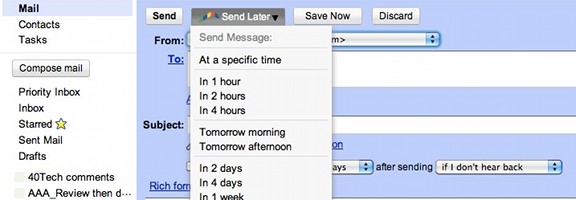
When you install the extension, a “send later” button is added to both the start and the end of your Gmail message box. Click on the button, and select the time when you want to send the message.

On their website, the Boomerang folks do warn that the extension is in beta, and that they can’t assume liability for missed or lost messages. Have any of you tried Boomerang for long enough that you can comment on its reliability? Boomerang is currently free while in beta, although the developers are asking each user to contribute what he or she feels that the app is worth.

Boomerang [via Lost in Technology]


Record This Info Now, Thank Us Later If Your Gmail Account Is Ever Compromised

gmail hacked

Last week we wrote of an important step that you should take to secure your Gmail account – associating a cell phone number with your Gmail account, so that you can receive a recovery code via text message.  As we pointed out, that’s not foolproof – a savvy hacker could change the cell phone number associated with your account.  Then what?  Google does offer an account recovery process, but it requires you to know the answer to several questions. Read more


The One Step You Should Take Today to Secure Your Gmail Account

gmail hacker large

Felicia Day, Internet celebrity and star of the original web series The Guild, recently had her Gmail account hacked.  She eventually recovered her account, although it isn’t clear whether her celebrity status played a role in the recovery.  What happens if your account gets hacked?  How can you get it back?

We’ve covered 7 Tips to Protect Your Email From Hackers, but what happens if your account has already been hacked? If you’re going to do nothing else, at least set up your Google account so that you can recover your account via text message.  Then, if your Gmail account is hacked, and if the hacker hasn’t dug into your settings too deeply, you can reset your password via a recovery code that Google will send to you in a text message.  Chances are, the hacker won’t have access to your cell phone (and, if he does, you’ve got bigger problems than just your hacked email).

To enable password recovery via text message, click on “Settings” in Gmail, and then on the “Account and Import” tab.  At the bottom of that tab, click the “Google Account settings” link.  On the page that loads, click the “Change password recovery options” link.  You’ll need to reenter your password and hit the “Verify” button.

Once you’re into the “Recovering your password” page, find the “SMS” section and click the “Add a mobile phone number” link.  Then, select your country and input your telephone number, and click the “Save” button.  If you entered your number correctly, you’re all set to recover your account via text message, in the even of catastrophe.

I haven’t tested to see if a Google Voice number would work as your recovery number, but, even if it does, you don’t want to use it.  If a hacker has your email password, he also has your Voice password, and may be checking that.

This system isn’t foolproof.  As best I can tell, there is no verification process to change the account recovery telephone number.  So, a hacker with your password could go in and change this number, and you’d be out of luck.  Still, an extra line of defense can’t hurt.

If you have any other tips for securing your Gmail account, let us know in the comments.


7 Tips to Protect Your Email from Hackers

7 Tips to Protect Your Email from Hackers | 40Tech

In the spirit of yesterday’s security-focused post, I wanted to share with you some tips on how to protect your email account from getting hacked. This list was originally put together by the folks at MakeTechEasier and was focused on Gmail, but many of the items are relevant to any web email client, and many other services besides. I’ve reworked the concepts for general use – if you want the just-for-Gmail step by step details, please visit the original post.

original photo by Don Hankins

1. Always check the URL before logging in.

Fake login pages are a problem with any site that hosts sensitive information. Even Craigslist was having this problem just last month. Tread carefully before you log in.

2. Avoid checking emails at public places

This may be a bit much for anyone in this mobile-focused world, but this is geared more toward avoiding checking email (or any private account) from a public computer. You never do know what sort of spyware has been installed on someone else’s machine.

3. Create a secondary email account

If you absolutely must login to your email account on a machine other than your own, create a secondary email account (with different login credentials, of course) and forward a copy of all emails from your original account to the secondary. This way, if you get hacked, your original account should remain uncompromised. Be sure to empty this account regularly – don’t use it as a backup for your sensitive messages. Also, don’t use it for your password recovery account…

4. If you are able, regularly check the IP of the last login

This is a nice Gmail feature, and is offered by some other webmail email providers as well. If you don’t recognize the IP that last logged in to your account – especially if it comes up often – you may have been hacked.

5. Check for bad filters

If your email service allows custom filters, there is always the possibility that one of them could be forwarding your messages to someone else. Regularly check your filters to see if there are any that you don’t recognize.

6. Don’t click on suspicious links

This one should be highlighted in bold, flash, and emit dangerous beeping noises. If you don’t know what it is – even if it is from a friend – don’t click on it. If it came from a friend, send them an email or call them to ask if it was really sent by them. This applies to email, Facebook, Twitter, a sticky note, or any other way a link might have been sent to you.

7. Choose a strong alphanumeric password (and add other characters too)

Some services don’t allow capitals or special characters in your password – avoid these services if you can. Use of funky characters is a great way to increase password strength. If you can get a password up to 16 characters, all the better. I know that these are a pain to remember, but you can always create a password base to help with that, or use a tool like LastPass or KeyPass to remember the password for you.

As a final note, remember what Evan suggested in yesterday’s post on Firesheep and Blacksheep: the only real way to be sure you are at least as safe as you can be when you login is to use services that require https and/or to connect via a Virtual Private Network. The TOR network is a great service if you want a free VPN, and there is even a TOR toggle extension for Google Chrome called Proxy Switchy!.

How do you protect yourself when you login to your email (or other) accounts?


Clean Your Gmail Inbox by Playing a Game

0boxer

If you’re like me, your inbox is not exactly tidy.  Gmail’s recently revealed Priority Inbox feature has helped, but getting through an email backlog can still be a chore.  To make cleaning your Gmail inbox be a bit less tedious, give 0boxer a try.

OBoxer is a service, complete with extensions for Chrome and Safari, that awards points and badges to you for processing messages in your Gmail inbox.  Once you install the extension, 0Boxer works automatically as you process messages.  You get points for every message written, archived, or deleted.  These points are displayed in a bar at the top of your browser window, as shown in the screenshot above.  You can also earn badges for certain achievements, such as reaching a zero inbox.  Your inbox will show a link to 0Boxer’s leaderboard, which displays the usernames of  the users who have the most points for the day, and the week.

You do need to use Gmail’s authorization feature when you set up 0Boxer, to give 0Boxer access to your account.  0Boxer only accesses stats about your activity (such as messages archived), rather than the actual content of messages.

Right now, 0Boxer only has extensions for Chrome and Safari, so you’re out of luck if you’re a Firefox, Opera, or Internet Explorer user.  0Boxer does work with Google Apps email accounts.

Is 0Boxer the type of app that would help you get through your inbox?  Or is it something gimmicky?

0Boxer [via Fast Company]