Menu Close

Category: Cloud (page 8 of 32)

Summify Cuts Through the Chatter, Helps You Get The Real Goods From Your Social Streams

Summify Cuts through the Chatter, Helps You Get The Real Goods From Your Social Streams | 40Tech

Summify has been acquired by Twitter and will be shutting down. See this post for more detail.

I’d like to take a moment to step away from the general worship and awe of Google+, and circle back (hehe) to our old friend Twitter. Actually, I plan to talk about Summify, and how it can take the often-overwhelming amount of information that is travelling through your Twitter stream at any given time, and sort it into a “highlight reel” that can be shared as a whole and as individual posts. It’s easy, it’s effective, and maybe just a little bit brilliant — and I have no doubt it will save you time and make your online reading much less hectic.

Multiple Accounts

Summify isn’t just about Twitter, either. Sure, it can connect to as many Twitter accounts as you like, but it also connects with Facebook and Google Reader. In fact, the more accounts you add, the better your summary will be.

Control

You get to decide how often you get a summary, how many stories it contains, when it gets delivered to you, how it gets delivered, who gets to look at it, and whether or not it gets published to your accounts. For example: my Summify is set up to deliver a new summary of 10 stories, twice per day (at 8:30am and 8:30pm), to my email inbox. Others can view it, and I automatically publish a link to the summary on my main Twitter and Facebook accounts. I could have allowed Summify to send me a Twitter DM notification as well, but between email and the recently released iPhone app, I’m covered.

summify-1 Summify-2

summify-2a summify-3

When you select a link in Summify (from email or your main summary), the article opens up with a handy toolbar on top (which you can close, if you want) that allows you to share the post on one or all of your connected networks. You can also see the avatars of the people who shared the article with you in the centre of the toolbar, and hover over them to view the originating tweet and click through to their account.

summify-5

If you don’t like the article and think it shouldn’t have been in your summary, you can click the little thumbs-down button to add it to your Filters list. This is a nice and easy way to weed out spammers and other annoying sites that occasionally sneak through. In fact, when you are in the Summify web app, itself, you can thumb an offending article down right then and there, without ever opening it. You can also filter by contributor, allowing you to block specific people from contributing to your summary. All you have to do is hover over one of the avatars below any given article, and then move your mouse over the little “x” that appears in the top right, and click it. This, and the thumbs-down functionality aren’t available in the email, of course, but they are also missing from the iPhone app; something that I hope changes, soon. Thankfully, though, Summify is smart enough that it gets it right about 98% of the time. And the iPhone app is pretty, and so is easily forgiven.

summify-4

People-Friendly Messages

When Summify sends out a summary message it takes great care to do two things: 1) It mentions some of the people who provided you with the information in the first place; which makes for nice Twitter etiquette. 2) It varies the messages so they aren’t always the same boring words with a new link. As an example, take a look below at three recent tweets (not clickable) that Summify sent out on my behalf.

tweet1tweet2tweet3

It should also be noted that mentions are automatically included in share of single posts, as well, and that you can edit the content of single-post shares before posting.

Easy, Good Looking, and Smart

Take the section-title anyway you like, but understand that it’s true, and it’s awesome! The apps (and even the emails) are easy on the eyes and easier to work with, and the service is smart enough to not only consistently deliver articles that you like, but it also will list out several other stories from websites that post multiple posts. This makes sure that you get all the highlights from Mashable and other large sites without having to visit them directly or open up another app.

I’ve been using Summify for a month or two now, and I’ve lost count of the number of hours I’ve saved by not scanning through the muck that is sometimes Twitter, and by not chasing down every shiny post in my 49 or so RSS feeds. Summify helps keep things clear and easy to manage, and has even kept me relevant on Twitter while I play with Google +. Speaking of Google +, I’m hoping that we’ll see it integrated into Summify soon (they already have the +1 button). Even better, Summify should be integrated into the Sparks feature! Now, that would be sweet! * pokes Google *

Note: For those interested, Summify is located right here in my (rarely) sunny home-city of Vancouver, and they have had the benefit of advising from the CEO of another little local social app called HootSuite. Maybe you’ve heard of it? :D

Give Summify a try and tell us what you think!

UPDATE: Summify has recently updated its look (pretty much the day after this post went up). It was pretty before, but now it’s awesome! It also includes Instapaper integration.

Summify-new.


See What Your Website Looks Like on Different Devices

screenfly.jpeg

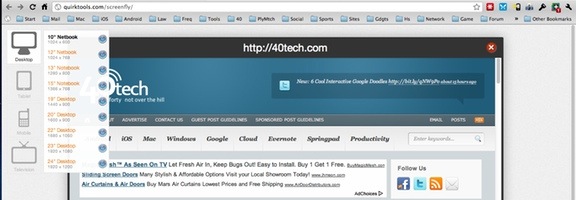
If you run a website, you’ve probably run into issues trying to figure out what your site looks like on various devices. If you want a quick way to figure it out, check out Screenfly, a site that lets you see how your site appears on different devices, including desktop, tablet, mobile, and even television. Within each of those categories, you can choose from a variety of devices. For example, if you choose tablet, you can pick between the iPad and four other tablets, including the Motorolla Xoom. Even the desktop selection allows you to choose between several screen resolutions.

Read more


GTD, Producteev, Evernote — Bridged!

GTD, Producteev, Evernote -- Bridged! | 40Tech

As you probably already know, GTD and Productivity are creatures that live somewhere deep in my bones. They speak to me, manipulate me, and generally run my life. Not in a bad way, you understand — even if they come across as a little obsessive, the little monsters really do have my best interests at heart. They’re the reason I’m always looking for new and inventive ways to refine and apply workflows. They’re also the reason that I’ve met some cool people who have their own little creatures that bitch and nag them into action.

During a recent conversation on Google+, with a circle of those people, we were discussing the benefits of both Producteev and Evernote as GTD tools, and how it would be great if they worked together. We decided to test out a means of making that happen, with Evernote as the ultimate collection tool, and Producteev as the magic task management/Google Calendar integrator.

Here’s what I proposed (have a read and tell me what you think):


The Gist of the Idea

The first thing to do is make Evernote able to send email directly to task@producteev.com. To do this, you need to register the email address that your Evernote uses (to email out a note) in your Producteev workspace(s). Now, any tasks in Evernote that you want to process into Producteev can be done directly from within EN.

The next thing you need to do is make sure your Evernote notes get to the right place in your Producteev setup. Producteev’s email2task functionality is fantastic. It incorporates a lot of simple language that allows you to easily do things like schedule a task from email by writing “Do this task tomorrow at 2pm” in the subject line (more on syntax below). If you are working in the Evernote desktop app, you can easily send out an email by selecting that option under Share, and then changing the subject line to reflect the appropriate email2task syntax. If you are in a mobile app, or unable to change the subject line for some reason, then you can simply change the title of your note to reflect what you want the email subject line to say.

These two steps make it possible to collect information in Evernote and share it with Producteev quickly and easily. Producteev can connect to Google Calendar, as well, for two-way sync (coming first week of February, 2012), which gives you the opportunity to finally connect Evernote to Google Calendar, if only by proxy.

Finally, using the Copy Note Link or Copy URL to Clipboard features found under the Note and Share buttons in Evernote, you can add the note’s own link to the email or note body, and leave an easy to follow link back to Evernote in any Producteev task you create.


GTD Use Cases for a Evernote-Producteev Bridge

  • You could manage your GTD system in Evernote, doing everything from collecting to archiving, but use Producteev during processing to set up automated reminders and Google Calendar events. You could also add in email or IM Producteev functionality to easily close and update tasks, including sharing and delegating without ever logging in to the tool itself.
  • You could also manage your GTD in Producteev and simply use Evernote as your main collection tool, as well as for keeping all of your reference material and archives in one easily searchable place. Producteev has many ways of inputting tasks, but Evernote can utilize voice, image, and text entry, as well as the clipper, and a crazy number of integrations, to collect and organize information.


Why Bother?

  1. Evernote has superior collection capability but no true task management functionality.
  2. Producteev’s notes system and ability to add attachments simply can’t compare to Evernote.


Notes

  1. When you send an Evernote item into Producteev, the body is converted to a note. Actually, you end up with several notes, as any images that Evernote uses in the background of the note are added as separate (and useless) note items in Producteev. HTML is stripped out entirely, and this will sometimes leave garbage code in the text of the Producteev note. See the image below (thanks to Daniel Gold for doing the first test run!).
  2. Even though the Producteev notes are in plain text, the note itself is still in both tools. In Producteev, the notes system can be used to conduct a conversation around the task with others who have access to the workspace, or to leave additional notes for yourself if you are using Producteev as your main management system.

GTD in Producteev Evernote Bridge | 40Tech    pdtv-en2.

GTD in Producteev, Evernote | 40Tech


General Workflow & Syntax

  • Collect in Evernote
  • Process to Producteev via Evernote email-out and Producteev email2task syntax (with scheduled items going to Gcal, as well, for the visual calendar)
  • Manage tasks in  Evernote with Producteev used only for scheduling and reminders OR
  • Manage tasks in Producteev and/or email with Evernote for archival reference


Syntax tips can be found here, but the basics are as follows:

  • today, tomorrow, days of the week, next week, specific dates (today 8pm, August 10 8pm, 8pm August 10 when combining date and time)
  • done (to register a task as being completed)
  • @ to assign a task to a workspace collaborator (@Michael, @Michael Lewis, @Lewis, @ML)
  • * to indicate a priority level using our 1-5 starring system (4* or ****)
  • # to indicate workspace name (#Personal)
  • ## to indicate the appropriate label (##Marketing)
  • “” to add task notes (“follow up” or ‘follow up’)
  • / to have the beaver run searches for you (/today for a list of all of your tasks due by the end of the day)


Your Turn!

So what do you think of the possibilities of integrating Producteev and Evernote into one system that is relatively seamless? Thoughts? Concerns? Is this worthwhile? Let us know in the comments!


How to Watch US Netflix on Your iPad/iPhone When Outside of the US

How to Watch US Netflix on Your iPad/iPhone When Outside of the US | 40Tech

If you have Netflix, you have the ability to stream a wide array of movies and television shows for less than $10 per month. The digital streaming library isn’t as impressive as their mail-out catalogue, but any way you look at it, that’s a pretty decent price for what you get. And what you get is a lot. Old shows, new shows, crazy amounts of anime, and even some favourites like Glee, the now (sadly) cancelled Stargate Universe, and 2009’s Star Trek movie are on there. Unless you live in or visit a country other than the United States, of course.

If you do happen to be on the other side of that imaginary border line, however, and you have an iOS device, you can use a VPN to access the US Netflix streaming library — and you can do it without spending a dime if you use Hotspot Shield.

Note: Please note that, while this is a fun workaround, and can be useful in certain situations, the inability to access Netflix or any other media site mentioned in this post outside of the United States is due to international licensing agreements. These sites and services may prohibit broadcasting or accessing certain content from outside of the United States in their terms of use. As such, this post’s workaround is used solely at the device owner’s and account holder’s own risk and is for educational purposes only.

UPDATE: Hotspot Shield’s iOS configuration page is currently down. I’ll keep checking to see if and when it comes back up and will update you here. You could also try other VPN options, such as Witopia, but that one comes with a $40/year price tag.

UPDATE 2: I’ve been in touch with Anchorfree support (they are the purveyors of Hotspot Shield), and have been told that they are working on the issue. Apparently, they are re-launching the iPhone version of the VPN. I will update again when I know more.

UPDATE 3: The iOS app for Hotspot Shield is officially here! Check this post for more info.

We’ve talked about Hotspot Shield before, and even though the free version forces ads down your throat, it’s pretty handy when you want to access Hulu, Pandora, or US-only website content from across the border. It’s also handy for surfing securely at public WiFi locations, and all of the other fancy things you can do with a VPN.

So why bother with an additional post just for Netflix? Because Netflix isn’t a US-only site, but it does have US-only content. This content is accessible depending on where you are, as I found out by accident when visiting a friend in Washington state a couple weeks ago. I pulled out the iPad for my kid, loaded up Netflix to keep her busy, and was immediately boggled by the amount of new content I found staring back at me. I was hoping that we Canadians had suddenly gotten a slew of new titles, but was sadly disappointed when I returned home that evening.

Out of curiosity, I tried out Netflix on my laptop with Hotspot Shield enabled. That didn’t work. Generally (unless launched via the Chrome app, oddly enough) Netflix thought that I was trying to access the US site with a Canadian account. No dice, there. Then I remembered that Hotspot Shield was also configured on my iPad… and I was pleasantly surprised that it worked!

Here’s how you can try it out

Go to the iPhone configuration page on Hotspot Shield’s website, and follow the instructions there. You’ll want to be on a separate device for this, for simplicity’s sake.

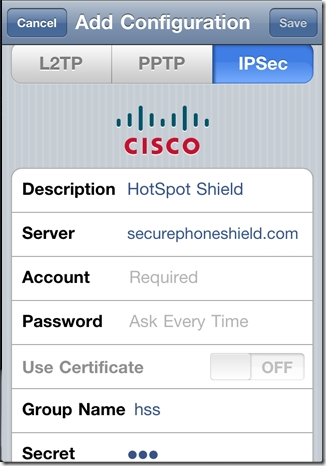
Basically, they will have you turn off your iPad’s (or iPhone’s) WiFi, and then head to Settings > General > Network > VPN > Add VPN Configuration. From there, you do the following:

  • Select the IPSec tab/pane
  • In Description, type HotspotShield
  • In the Server field, type 68.68.107.101
  • Go back to the website and click the “Get Account ID” button
  • Type the code that the button generated into the Account field
  • Type the same code into the Password field
  • Make sure that Use Certificate is set to OFF
  • In Group Name, type hss
  • In Secret, type hss
  • SAVE and then turn your WiFi back on

Hotspot Shield iPhone Configuration

Once you are set up, turn on the VPN. I’ve noticed that, if you try and turn it on from the iPad’s Settings dashboard, it will fail to connect. No idea why that is, but, if you turn it on from the Settings > General > Network > VPN switch, it connects just fine. Once the VPN says it’s connected, load up Netflix and watch in wonder as the app believes that you are in the United States and loads up the US Netflix library!

Things to note

  • The VPN will slow you down a little bit, but not enough to affect video playback. Netflix technology is very good at figuring out how to play videos optimally, even at slower speeds.
  • The VPN will disconnect periodically. This is annoying, but if you are already playing a video it will not affect it. The movie or TV show will play through to the end unless you pause it and let the iPad time out. If you find that you are having difficulty launching a show, check to see if the little VPN icon is in the upper left corner of the iPad’s notification bar. If it is, then you may need to restart the app. If it isn’t, then head back into the VPN settings and turn it on again. You may want to close Netflix out completely, first to make sure that the VPN takes with the app (double-tap the iPad’s hardware button to see the running/recently running programs, press and hold Netflix till it shakes and gets an X in the corner, then tap the X to close it).

There you have it! Access to US Netflix on your iPad whether you have a non-US account, or just happen to be visiting another country. It is important to note that this trick may only last until Netflix figures a way to block it out, but HotSpot Shield is versatile. They have managed to get people back into Hulu every time they’ve been locked out so far, so it will probably be the same with Netflix.

Thoughts?


Browse Securely and Privately, For Free, With Cocoon [Firefox Add-On]

cocoon

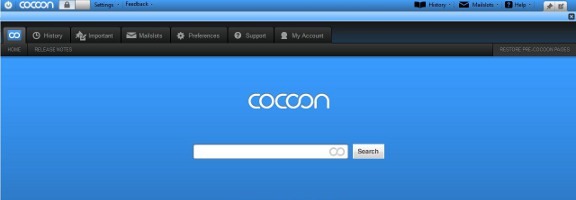
We’ve previously talked about ways to protect your email, or your web surfing, from hackers. One of the surest ways to protect yourself when on a public WiFi hotspot is by accessing the Internet through an SSL-encryted tunnel. Most services that offer that, though, cost money. Enter Cocoon, a free Firefox add-on that sends all of your browser traffic through an SSL encrypted tunnel.

Read more