
I just confirmed with the CEO of Memonic that the crazy premium account deal ($3.33 Euro for 10,000 notes and 50GB storage) link works until the end of October. And it works for whomever, not just the Swiss/Germans. Translate the page from German and get it while it’s hot!
There’s been a lot of discussion on 40Tech about which is the best note-taking app. While the battle is generally between Springpad and Evernote, occasionally a new option steps in for a punch or two. This week’s contender has been watching, learning, and in many cases even improving upon the competition. I’d like to introduce you all to Memonic — there’s a reason it made App of the Week.
When it comes to note-taking apps, there are five key things to look for: how easy it is to get information into the app, organization and sharing features, overall usability, cross-platform possibilities, and personal preference. That last is a huge factor in user adoption. Depending on what you need your notes app to do, one or another may work better for you.
Evernote, for example, is well suited to those who just need a straight ahead, highly searchable portable filing cabinet. It can do many other things, true, such as be used for a GTD system, but portable (and searchable!) filing cabinet is what it does best. Springpad, on the other hand, is great for taking notes, but has this fantastic capacity for making certain types of notes “smart.” If you like to comparison shop, find good deals, or get value from what the people in your network are interested in, Springpad’s note-alerts system offers you something no other note-taking app can match.
Memonic doesn’t have the budget that Springpad or Evernote has. They’ve been bootstrapping their system for a while now, and when you consider that and then see what they’ve put together, I have no doubt you’ll be impressed. I was — and am. Just as Evernote and Springpad differ in their approach and target markets, Memonic has brought its own angle to the field: research and collaboration. Now, before the Evernote lovers start touting shared notebooks, and the Springpad-enamoured bring up the oh-so-very-cool Board, hear me out. Those are all excellent features — but if you want an app that makes it easy to share and organize notes on a project (or projects), easy to be notified when new notes and research snippets have arrived or been commented on, and ridiculously simple to gather information in the first place, then Memonic is the clear choice. Here’s why:
Groups
Memonic can be used as a central collaboration notebook for research, planning, and discussions on projects. You can create a group, invite a few people, and then get to work. The group gets its own page with its own activity feed, too, which makes it simple to be notified and to keep an eye on progress.
If you run into the ever-present problem of working with someone who doesn’t want to use the service, sharing notes with people outside of Memonic is easy, too. You can share via Facebook, Twitter, email, or a link, RSS feeds, and you can even embed notes on web pages — which is a nice touch.

The Dashboard
Memonic’s group and contacts features are fully realized with the feed-like Dashboard. The Dashboard not only shows you a quick clip of everything you’ve posted recently, but it also shows the public posts of your contacts — which can be opened and read in full right from the dashboard itself. See something you like? Copy it to your own collection of notes, or share it with others via email, link, Facebook, or Twitter (or even copy it to Word) with just a few clicks.

The Best Clipper I’ve Come Across
I love the Evernote Web Clipper, and I like the Springpad Clipper even better, but both can get a bit irritating if you’re in a hurry. Memonic’s clipper does away with the click and drag highlighting and breaks each section of content on a page into regions that can be selected with a single click. You can do multiple parts of the page, or even the entire page in one go. When you’re doing a lot of web research, this speeds up the process immensely.

Quick content selection isn’t the only reason the Memonic clipper stands out over the others. The other big one is Gathering Mode, which is a little toggle switch that allows you to lock in your settings for where you want to put your notes — folder, privacy level — and save you the trouble of having to re-establish those settings for every single clipping. It’s awesome — and I have no idea why other clippers don’t do the same. The only thing I would like to see added to Gathering Mode is the ability to lock in tags, as well.
Finally, the Memonic clipper has a variety of other useful modes that can replace a number of other services with just this one:
- Read Later mode that allows you to grab entire pages
- Bookmark mode (which provides a nice snippet description as well)
- Screenshot mode that attaches an image of the visible browser area
- Write a note (to get to the note taking without even opening the service)

The web clipper works with all major browsers — and even works by bookmarklet with Safari for iPad. If that isn’t enough, there is also a clipper for Windows that allows you to clip content outside of the browser.
Clean and Simple Design — Across all Platforms
Memonic focuses on the minimal. The way notes are displayed in expandable windows that are neatly separated from one another is easy on the eyes and easy to use. The look and feel is distinctly uncluttered, and is fairly persistent across all versions of the app. And you can get Memonic pretty much anywhere: Windows and Mac desktop apps, iPhone, iPad, Android devices, and the web app for everything else. Mobile versions don’t have the Dashboard, unfortunately, but everything else you could want is there, both online and off.
Crazy Integrations
For a small operation, Memonic is throwing around some important integrations, especially for the business set. Here’s just a few: Salesforce, SugarCRM, Confluence, Sharepoint — and guess what… they are planning to integrate with Evernote! That may seem a bit weird, but soon, all those who can’t bear to walk away from Evernote, but love the power of the Memonic clipper, will be able to use the super-awesome clipper to save content directly to their Evernote accounts. A nice, tidy little bit of genius on the part of Memonic, if you ask me.
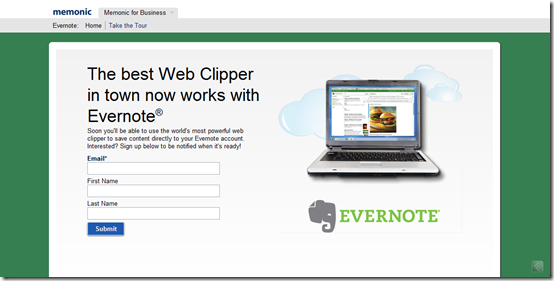
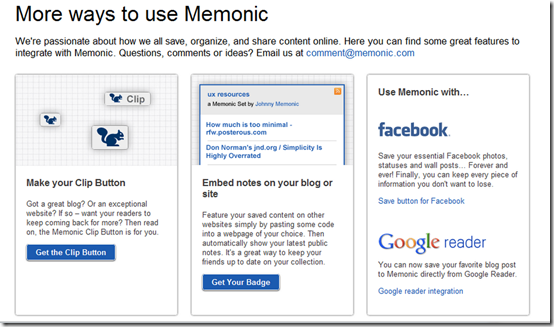
If, for some strange reason, you need more than the promise of Evernote integration, well, Memonic also integrates a save button into Facebook so you can save your favourite photos, status updates, and wall posts. Want more? How about Google Reader integration so you can clip your favourite posts while reading your feeds? How’s that tickle you?
Memonic’s co-founder, Dorian Selz, and the rest of the team have worked their butts off on a bootstrap budget to put together one of the most robust note-taking apps I’ve ever come across — a definite rival for Evernote and Springpad if it gets the notice it deserves. The only issue I personally have with Memonic is that their free version is limited to only 100 notes and doesn’t have Gathering Mode. To get the full service, though, only costs $28/year — which isn’t bad considering Evernote premium is $45/per year — and Memonic doesn’t have any advertising to clutter up your experience. If you do a lot of research on your own, or as part of a student or business team, give Memonic a try — you just might love it. And there are discounts for students, too.
What do you think of Memonic?








How Important Are Grammar And Spelling Online?
One might think that the world wide web, which is still predominantly text-based, would be the spearhead in the rise to new heights of literary articulation. Unfortunately, if you were the one who was thinking that, you were sadly misinformed. In actuality the ability or willingness to write with proper grammar and spelling has been replaced by a general acceptance of a lower standard. The acceptance appears general, that is. Where do you stand on the subject?
Image by JD Hancock
I confess that poor spelling and grammar is a pet peeve of mine. When I am reading something that runs rampant with glaring errors, I find it difficult, irritating, and that the work loses credibility in my eyes. There are levels, however. While misspellings like “definately” and “loose” (for lose) always make me cringe a bit, I make allowances for posts and comments that have mistakes in them. I recognize that, while English is the most prominent language on the web (at least in my own experience), many of the active participants of the social and interactive super-real-time web are not native speakers (or writers). If I were to have to communicate in other languages, I have no doubt that my writings could easily be the stuff laughing stocks are made of.
Where I draw the line, however, is with “texting” or “IM” style writing. Some of that has its place, too — or had, before the mass adoption of full hardware and software keyboards — but forgive me if I think that there is never a good excuse to write “wat” in place of “what.” That’s almost enough to get me to stop reading altogether. I also can’t stand l33t. Practically unheard of for a tech-geek, I know, but the secret code of elite nerds always struck me as a really annoying oxymoron.
Now before those that are inclined start tearing apart some of the grammatical inconsistencies of this post, I should mention that I am ok with conversational writing. That is to say that I don’t mind some liberties being taken to convey tone and flow that, on some level, emulates how two friends or acquaintances would talk with one another. In fact, I think that sort of writing is essential on the web. It is part of what makes a blog post resonant, and helps the reader and writer to identify with one another. How far I’m willing to accept this style of writing is dependent on the subject matter, the points I made above, and quite likely, my age/maturity level while reading. And I’m fully aware and accepting of the fact that my maturity level can fluctuate… :P
Is my acceptance of even a limited degradation of writing on the web part of the overall problem? Probably. Is it one of the factors that leads to established journalists getting lazy (and sometimes disappointing) with their writing? Again, probably. It’s all tied in with other factors like language barriers and the attention deficit fostering speed of the online world. Is there a line that should be drawn in the sand somewhere, though? Should people be publicly flogged for ignoring the oh-so-convenient spell-check integrations out there? Personally, I think that spell-check, auto-correct, and especially auto-complete are actually part of the problem. Since I started using the iPhone and iPad, for example, I have noticed a marked increase in mistakes while typing on a full keyboard — especially with contractions.
What about you? Where do you draw the line — or do you care at all? Why?