

Menu Close

Category: Android (page 10 of 11)

Techies Think 7 Inches of Samsung Will Work Just Fine

Samsung Galaxy Tab | 40Tech

The tech community seems to be almost overwhelmingly positive about the new Samsung Galaxy Tab. Some of that is because the tech community tends to love the openness of Android, and some of that is because the Tab is a shiny new toy — but much of it appears to be because Samsung’s new tablet is actually pretty cool.

Check out the video, below, from Stuff.tv. It’s one of many reviews and unboxings that I’ve come across that sings a balanced tune about the Tab’s goodness. Some highlights are as follows:

  • The smaller size of the Tab is a good thing, as it can fit in a (large) pocket and is easier to type on than an iPad (for people focused on thumb-typing).
  • Having Flash on a tablet is awesome and it appears to work pretty well, even on 3G.
  • Samsung and Carriers have pre-loaded “helpful” software (or bloatware) onto the device.
  • The interface, while infinitely more configurable, is not a slick as the iPad — but it does the job.
  • People will like it, no matter what Steve Jobs thinks.

My last two highlight points, above, were mentioned in every single positive review I read, watched, or skimmed, and though there are a few negative reviews out there, many of them come of as Apple fanboys doing what Apple fanboys love to do: trashing things that are not Apple. There are a some reasonable points to take away from the negative reviews, however, such as the difficulty that first time users of the Tab can have with finding the “on” button, and the fact that Android 2.2 was simply not built for tablets (just like Google said it wasn’t) and that leads to the occasional performance hiccup.

Overall, it seems that the Samsung Galaxy Tab will be a reasonable alternative to the iPad, even if it will never quite achieve the elitist notoriety of an Apple product. What do you think?

Samsung Galaxy Tab Video Review [Stuff.tv]
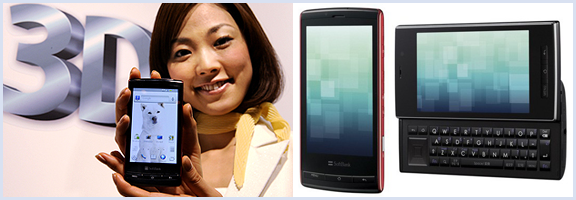

Do We Really Need 3D-Enabled Cell Phones?

Do We Really Need 3D-Enabled Cell Phones? | 40Tech

I may be one of the few left on the planet that is underwhelmed (and often annoyed) by the 3D-everything craze. I understand that it is the current reality of the video and gaming world, and I admit that 3D-TV tech is pretty cool, but I really don’t need all of my media to pop out of the screen at me. Plus, it hurts my sensitive, near-35 year old eyes — and I don’t like to wear the glasses. That said, it appears that Sharp is attempting to address at least the latter part of my whining with the advent of their new 3D cell phones.

You heard me right, 3D cell phones. The Galapagos 003SH and 005SH are the latest iteration of the Android handset, and sport the nifty, no glasses, 3D-screen tech that is reported to be used in the upcoming Nintendo 3DS.

The tech itself is both innovative and awesome, there is no question of that. It uses a parallax barrier system that specifies where it directs light (to the left or right eye) via a series of vertical slits. This creates a sense of depth and allows for a 3D environment on an otherwise normal LCD screen — again, without special glasses. By all reports, the effect is stunning, and Engadget reports that there are already some mobile games publishers on board (Capcom will be bringing Mega Man, Resident Evil, and Ghosts ‘n Goblins to the new devices).

Like I said, this is some pretty cool tech — but is it necessary? PDA screens are already hard on the eyes. Do we really need to add another layer that will have people staring even harder at their screens? Is it even necessary to have 3D gaming on a cell phone — or anywhere? I mean, it’s not like its an interactive hologram or anything like that — though that is getting closer, too.

What do you think about the latest innovation in mobile and 3D technology? For? Against? Happily indifferent? Tell us why in the comments?


Two Free Android Apps to Control Your Computer (Windows, Mac, Linux)

Two Free Android Apps to Control Your Computer Windows, Mac, Linux | 40Tech

If you have an Android device and want to use it to control your desktop’s (or laptop’s) mouse and keyboard, two of your best free options are RemoteDroid and Gmote.

RemoteDroid is a minimalist’s dream — nothing fancy to its wireframe trackpad/button look — and is a little light on the feature side of things, but it is a great way to control a presentation or media PC. It also handles multitouch gestures, such as the two-fingered scrolling option of multitouch trackpads.

Gmote does a little bit more than RemoteDroid, such as allowing you to serve media content from your PC to your Android device. No multitouch trackpad support here, and there are some media playback issues when streaming, but playback to devices is still a beta feature, and the developer seems to be active with updates.

Both of these remote control apps require you to download a server program to your Windows, Mac or Linux machine, and both are available for free. If you need a way to generally control your desktop or laptop remotely, or want a convenient media centre remote control, then give these two a try.

Have you tried any alternative remote control apps for Android? How do they stack up?

RemoteDroid vs Gmote: Remote Control Your PC with Android [Tested.com]


My iPhone Just Killed My FRS – Hello HeyTell

My iPhone Just Killed My FRS -- Hello HeyTell

I used to love my FRS. I didn’t have to pay for anything; I could talk to people a fair distance away — and it always reminded me of playing with walkie talkies as a kid. Good times. Well, those days are gone. The iPhone/Android app HeyTell has put the proverbial smackdown on my FRS use — when it comes to other HeyTell users, anyway.

Read more


What Is Worse: Apple’s Restrictive App Store, or Android Bloatware That You Can’t Remove?

android bloatware vs iphone restrictiveness

Engadget posted an interesting article yesterday, pondering whether carriers are destroying Android, by preloading Android devices with “bloatware.”  The article compared this to what happened in the PC industry, where computer vendors loaded all sorts of crapware on machines, filling up the drive and slowing the system down.

It’s deja vu all over again for mobile phones. More and more devices I look at are coming installed with applications I don’t want, often popping up messages to try and upsell me on services I have no interest in. Even worse, unlike PCs where offensive applications can be removed or the OS reinstalled cleanly, there’s often nothing that can be done to get rid of unwanted mobile software without arduous work.

The iPhone certainly restricts what apps can get into the App Store, but at least the user isn’t forced to keep an undesirable program on the phone (aside from the basics, like the App Store app, the Photo app, Mail, etc.).  Or is it worse to not have access to certain apps at all, like on the iPhone?

You tell us – what is worse, a smartphone where you can’t even get certain applications because of a restrictive app review process, or a smartphone preloaded with garbage that you can’t remove?

Entelligence: Will carriers destroy the Android vision? [Engadget]

Photo by svensonsan.