
Menu Close

Category: Windows (page 7 of 10)

Personalize Your Windows 7 Experience: Hidden Themes

Personalize Your Windows 7 Experience: Hidden Themes | 40Tech

Windows 7 is likely the best operating system Microsoft has ever put out. Oh, I’m sure some of you die-hards out there will still swear up and down that it’s Windows 98, 2000, or even 3.1 — and you Mac folk can just go ahead and tamp down on those comments bubbling to the surface of your elitist brains right about now — but when you consider the mix of power, beauty, and function, Billy Gates and crew have finally hit the sweet-spot with their latest OS.

One of the greatest things about Windows 7 is the customizability; there are a lot of different things that you can do with it to improve your overall user experience. Some of those things are fairly obvious, and some are a bit of a surprise, but many can be done quickly and easily, even by the non-techie, sometimes with the help of a handy tool or two. This series focuses on some tweaks for personalizing your own Windows 7 setup with as little fuss as possible. Let’s start off with the hidden themes that are just hanging about in your Windows folder.

Hidden Themes

You probably already know that there are several theme-sets that you can apply in Windows 7 with little more than a click, but on the off-chance that you didn’t, head into the Control Panel, look for Appearance and Personalization, and select “Change the theme.” You can also right-click on the desktop and select Personalize from the context menu.

Once inside, you’ll find all of your pre-installed themes, and you can even create and save your own. What you may not have realized is that, depending on your Windows version, you could have anywhere from five to a dozen or more other themes hidden on your system, just waiting for you to find and install them!

Theme Personalization in Windows 7 | 40Tech

You may have noted that, in the pre-installed themes, one of the ones under Aero Themes is named for your country — I have one called Canada. What most don’t realize is that, skulking about in a hidden folder, are themes from other countries as well. Some of them are quite nice, too, containing wallpapers that have beautiful scenes from each respective country. Here’s how you find them:

  • Open up a folder and click on the white space in the address bar to select and delete the text there, and then copy and paste the following and hit enter: Windows\Globalization\MCT
  • If you find you can’t access the folder or its files, you may need to follow the steps below to unlock hidden files and folders (otherwise please skip to the next main point): 
    • Open your Control Panel and click on Appearance and Personalization.
    • Near the bottom of the list, you should see Folder Options, and just below it, the link “Show hidden files and folders” — click it.
    • In the little pop-up window, be sure that the the radio button for “Show hidden files, folder, and drives” is selected. If you don’t see it right away, double click the “Hidden files and folders” folder — it should expand and you will find the button.
    • Click Apply and OK to close the window. If you are given any warnings by Windows that you could severely screw up your system, acknowledge them — see the next point to learn how to not make such warnings a reality…
    • You will now be able to see files and folders that you couldn’t see before, and they will have a slightly translucent or “greyed-out” look to them. Leave them alone, where possible, and for the timeframe that you are able to access these files, for the love of all that keeps you sane, DO NOT DELETE ANY OF THEM!!! They are generally hidden for a reason — that reason being so that you don’t muck up your system.
    • To save yourself from accidents when you are done with the theme-getting, just repeat the above steps and re-select Don’t show hidden files, folders, and drives,” hit Apply, OK, etc.
  • You could also try to browse directly to the folder via the C: drive, but I found that I couldn’t find the folder that way, even with hidden files and folders available.
  • In MCT, you will find several other folders with the name format MCT-XX. Click on any one of these and you will find a folder with the name of a country, a folder called RSSFeed, sometimes one titled “Websites for X”, and one called Theme. For example, the folder MCT-AU contains the country of Australia.
  • In the folder named after the country, you will find six wallpapers, which you can use to get a feel for what the theme is about, and can do with as you will — but head over to the Theme folder for easy setup.
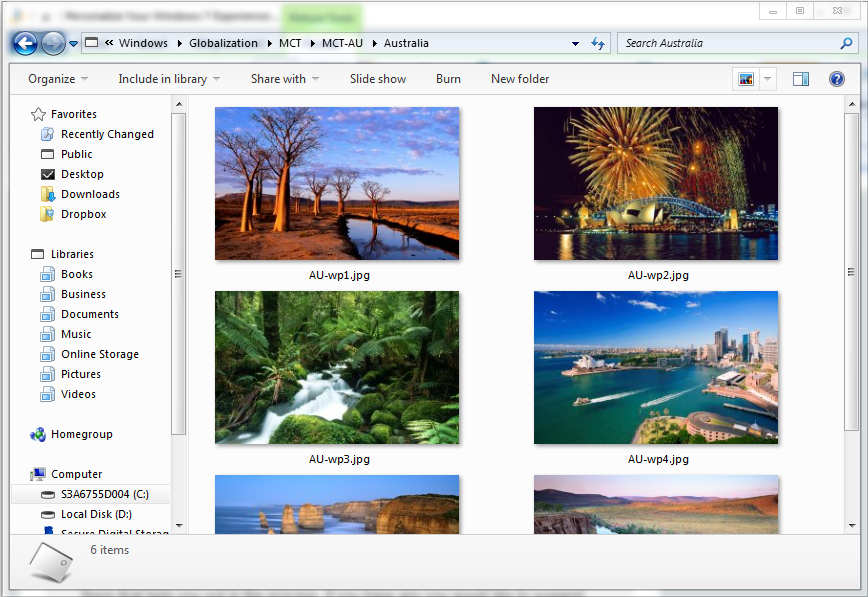
Hidden Country Themes, Australia, in Windows 7 | 40Tech

  • In the Theme folder you will see XX.theme. If you want to install that theme, click on it. At this point, you will get a chime from Windows, and your desktop will fade behind a Please Wait sign. After a moment, the sign will fade away and your new theme will be applied — rinse, lather, repeat as necessary!

As the theme is installed, your Control Panel will also open up to the Appearance and Personalization settings, and you will notice the new country theme under your My Themes section. If you want to change away from the new theme, simply click on a different one or install one for a different country. Once the theme you just installed is inactive, if you want to get rid of it, simply right-click on it and select delete. You can always reinstall it later.

Over the next few weeks, we will be posting other simple tweaks and tricks for personalizing your Windows 7 installation, as well as looking at some of the tools out there that help you out in the process. If you have any you would like to suggest, leave a comment, catch me on Twitter (@bobby_travis), or send me an email from my 40Tech contact page.

What countries were in your hidden themes folder?


7 Useful, Free, Programs That Make Computer-Life Easier

7 Useful, Free, Programs That Make Computer-Life Easier | 40Tech

Today, 40Tech is pleased to present a guest post by Dan from Test Freak, a technology review and price compilation site.

Across the internet there are pages and pages of documents, photo’s, applications and more. Within all of this it can often be hard to find the gems that can brighten your day or make the day easier. Because of this, I’ve compiled for you a list of useful programs that you may have missed when roaming through the vast web space. Not only are they useful but all of the below programs are also completely free!

Avast!

Everyone’s computer needs protecting from the vast amounts of malicious viruses that have turned up over the past years created only to cause harm and distress to other users on the internet. In order to protect yourself, a good antivirus program should be the first thing you head for once a computer is up and running.

Thankfully there is a large market for antivirus products leaving users with a wide choice of what’s best for them. For me and many others, the best choices are those that require no outlay of money — and surprisingly, there are still many varied options available that are completely free such as AVG, Avira, Avast! and more.

One of the best of these is arguably Avast! which is currently protecting my system and many others. Avast! is favoured by many due to the features provided and its solid ability to lock out malicious content. The application features a variety of real time shields which are actively protecting your use of the computer. For example the web shield is able to protect you whilst surfing the web by checking the connections you are making. If it finds a website containing harmful content the connection is instantly blocked, stopping viruses from reaching your computer.

Free Antivirus Software | Avast!

However if problems do crop up on your system, Avast! is equipped with a scanner to check over your whole computer in order to root out and eliminate any viruses that are present.

Another very useful feature of Avast! is its self-maintenance, it is able to update its virus database without user interaction and does so on an almost daily basis making it very useful for those not completely clued up on IT systems.

Process Blocker

One of the most annoying things about these viruses is their ability to continually restart themselves, much to the user’s annoyance. However it’s not just viruses that have picked up this trait; many programs can be found which start of their own accord and continually start even when told not to, particularly things such as program updaters.

This is where Process Blocker (beta) comes in, a tool which is able to automatically block programs from starting as soon as it detects their arrival; handy for stopping unwanted programs and saving precious memory space.

Stop Unwanted Programs with Process Blocker for Windows (Beta) Process Blocker for Windows (Beta)

It’s also incredibly simple to use, with users simply having to direct Process Blocker to the unwanted program file and it to the block list. From here it will be blocked every time that program’s start-up is detected. An option can even be set to allow the blocking of a process if it has been renamed, making this a very handy little tool.

7-Zip

7-Zip is another program that is great for those of us who like to save cash. Many files today are sent in a compressed format, and groups of files are often archived into a zipped file before being sent to others, making them easier to keep track of and smaller to transfer.

However when they get to their destination they need to be unzipped and so need a program to do this. Often, people will pay for these programs such as WinRAR or WinZip but there is no need. 7-Zip is capable of unpacking many of these file formats without the need for you to part with a penny.

It is also capable of packing files itself using its own format of .7z, meaning that this free piece of software has you completely covered when you need to unzip files, work on them, and then package them back up to go elsewhere.

Recuva

I’m sure we’ve all done it in the past: deleted something only to regret it a few moments or even weeks later. Thankfully another one of our top free internet applications has you covered. That application is Recuva.

Recuva is a piece of data-recovery software capable of retrieving information even when it has been permanently deleted and reallocated as free space, up until the point that the free space is over-written with new data.

The application itself is very easy to operate. Simply open it up and follow the on-screen wizard. You’ll first be tasked with selecting the type of file you are looking for and then where to look for it. For files you are unsure about, the option to search everywhere is available.

Recuva | Recover Lost Files, Deleted Files for Free Recuva | Free Data Recovery Tool

After this short wizard, Recuva zooms off, searching your drives for the specified file-type and returns a full list of everything it has found. From here, you simply select the files you want, click recover and hey, presto! Your files are back, saving you from a potentially disastrous situation!

Paint.NET

Paint.NET, as the name implies, is an image-editing program and works surprisingly well as an alternative to some of the larger software packages in the genre, such as Adobe’s Photoshop collection. Whilst it does lack many of the features present in Photoshop, it is still a fully competent photo-editing application that provides a substantial upgrade from the basic Paint program bundled in with Windows.

Free Photoshop Alternative, Easy Photo, Image Editor | Paint.NET

Paint.net provides a good blend between the two scales of drawing packages, maintaining the ease of use and clear layout found within paint whilst providing several of the advanced features found in Photoshop. These features include layer-based editing, allowing you to manipulate one part of the image without risking the whole project, along with artistic adjustment tools in order to affect colours, levels and image effects.

Audacity

Once you’re done with editing images, why not try your hand at editing sound with Audacity. Audacity allows you to very simply edit pieces of music by cutting, pasting, and remixing the track. This can be done through music files already stored on your computer but can also be done through your own music played by yourself. Audacity features a built in recording function allowing you to capture your music before bringing it into the editing stage.

The editing section is also very easy to use due to its simple nature, with the interface providing direct access to the basic controls whilst hiding more complicated and advanced features away within sub menus. Basic controls include tools that allow you to select certain sections of the track, move them around, delete them entirely or copy them for later, repeated use.

Audacity | Free Audio Editor, Free Audio Recorder

Along with these, more advanced tools are also available in the effects menu, which allows you to change things such as the speed, tempo, pitch and more. These tools should allow you to easily and quickly enter the world of audio editing and provide a great deal of fun. If nothing else, everybody likes taking their favourite track and turning it into a chipmunk version, right?

VLC

Once you have finished with your audio track, why not play it back to friends and family with VLC. VLC is a media player capable of playing many different file formats, from files stored on both hard drives and physical media. It features the ability to decode and play many different codecs, and is able to play many files that other players simply cannot, allowing it to become your one-stop-shop for playing video and audio files. I’ve yet to find a single file that it can’t play, which is why it has earned its place on this list of useful programs.

As with most programs on this list, it also earns bonus points for being incredibly easy to use, with the initial interface only offering the most basic controls and making the program nearly incapable of confusing any of its many users. However it also features a few more advanced functions that improve its usefulness even more — such as allowing content to be streamed, the video to be cropped and resized, and audio re-synched. A few more fun features can also be found in the effects and features menu such as options to invert the colours, turn the video into a cartoon or even make the video into a puzzle game that needs to be reorganised in order to watch the film normally.


While this list provides a few great – and free — programs that you may have missed, it is by no means all-inclusive. If you’ve found a great free program, pop it into the comments below and tell us why you think it should be here!


Evernote Pre-release Enables Notebook Sharing from Desktop [Windows]

Evernote Pre-release Enables Notebook Sharing from Desktop [Windows] | 40Tech

One of my biggest beefs with Evernote has always been the lack of an efficient way to share notes and notebooks. In fact, the lack of convenient sharing features was one of the reasons I considered a move to Springpad. Notebook sharing was a step in the right direction, and has been available in the web app for a while now, and even appeared in the Mac beta back in December. Unfortunately, Evernote’s excellent Windows desktop version has been sadly lacking — a source of niggling frustration for many users. It appears that that is about to change!

Evernote Windows Notebook Sharing Feature | 40Tech

If you want to the ability to access and update shared Evernote notebooks right from your Windows desktop app, all you have to do is click on the tools button, select options, and then check the little empty check-box under the General tab that says “Update to pre-release version when available.” Once that’s done, just click ok and then head over to the Help menu button and select “Check for updates.” Follow the prompts and upgrade Evernote.

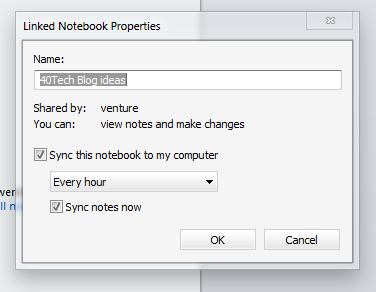
Once you are upgraded (current pre-release version is 4.3.0.4167), you will see that your Notebooks area with have two buttons: Account and Shared. Selecting the Shared tab will show you your shared notebooks, but you will probably not find any information in them. To fix that, simply click on the notebook and the properties window will pop up. Once there, adjust your sync time-frame, make sure that “Sync notes now” is selected, and click OK to update your local Evernote database with the shared notes! Do this for each shared notebook that you want to be able to access locally.

Share Notebooks from Evernote Desktop for Windows | 40Tech

If you want to start sharing notebooks — or modify permissions, or stop sharing — click the Manage Sharing button. The Notebook Sharing page inside the desktop application is easy to look at, and easy to navigate.

Evernote note sharing is nearly complete! The only things left to do would be to add this new Notebook Sharing functionality to the Evernote mobile and tablet apps — and hopefully, one day, offer up a way to share individual notes by more than just email.

How excited are you by Evernote for Windows’ new Notebook Sharing feature? Will you update to the pre-release?

Thanks to 40Tech reader Daniel Gold for the tip!


Google’s Cloud Connect Syncs MS Office with Google Docs

Google’s Cloud Connect Syncs MS Office with Google Docs | 40Tech

There are several ways to sync Microsoft Office documents to the cloud (we covered three here), but until now, not one of them was made by Google. Whether that statement sparks feelings of warm and fuzzy quality in you, or makes you shudder in fear as Google officially digs its fingers into your Office docs, Google Cloud Connect has taken off the training wheels and been released to the world at large. Besides, if you are of the latter persuasion, chances are you haven’t bothered with the Google account that the service requires.

Cloud Connect adds a toolbar to the Microsoft Office interface that effectively accomplishes two things:

  1. Giving MS Office the online capabilities of Google Docs — and this is a good thing, as Microsoft’s cut-down web offering of Office can be somewhat unwieldy by comparison.
  2. Finally gives Google Docs the offline capability it has always needed to make it truly relevant in today’s workplace, which is still a few years away from going fully to the cloud.

Google Cloud Connect works on Windows XP, Vista, and Windows 7, and is available for Office 2003, 2007, and 2010. Check out the video below for more information on its capabilities.

http://www.youtube.com/watch?v=H12teRzulW0

New Ways to Experience Better Collaboration with Google Apps [Google Blog]


Restore Abandoned Windows Features With Classic Shell

LittleSnapper.png


Do you miss the “up” button in Windows Explorer, now that you’ve moved on to Vista or Windows 7? Or maybe you just appreciate the look and feel of the Windows XP start menu? If you want to bring back a long-lost Windows feature, chances are that you can restore it with Classic Shell.

Classic Shell restores features that were present in older versions of Windows, but are missing from Vista and Windows 7. The two main components of Classic Shell are Classic Explorer and Classic Start Menu.

Classic Start Menu has a long list of features. For example, after installing it, you can drag and drop to organize your applications, display recently used documents, and right-click an item in the menu to delete, rename, sort, or perform other actions. You can select from several skins, download ore from the Internet, or, if you’re handy, make your own.

The Classic Explorer adds a toolbar to Explorer. This toolbar adds several operations, such as Go to parent folder, Cut, Copy, Paste, Properties, and Email. Classic Explorer also replaces Vista and Windows 7’s copy UI with a version similar to XP’s version. You also can restore the “Up” button to the toolbar.

For a full list of features of Classic Shell, check out the Classic Shell site. Classic Shell is free and open-source software.

Are there any classic Windows features that you miss in Vista or Windows 7?

Classic Shell [via Geek Tonic]