Menu Close

Author: Bobby Travis (page 25 of 51)

Bobby isn't 40-something, but is a strong supporter of the Grown-up Geek kind. He's a loving husband and father first, but is also a freelance writer, productivity nut, operatically trained singer, and (not-so) closet geek.

Check out his random thoughts, wackiness, and Instagram pics on Tumblr, Twitter, or Google+-- or just head over to bobby-travis.com.

Google’s Cloud Connect Syncs MS Office with Google Docs

Google’s Cloud Connect Syncs MS Office with Google Docs | 40Tech

There are several ways to sync Microsoft Office documents to the cloud (we covered three here), but until now, not one of them was made by Google. Whether that statement sparks feelings of warm and fuzzy quality in you, or makes you shudder in fear as Google officially digs its fingers into your Office docs, Google Cloud Connect has taken off the training wheels and been released to the world at large. Besides, if you are of the latter persuasion, chances are you haven’t bothered with the Google account that the service requires.

Cloud Connect adds a toolbar to the Microsoft Office interface that effectively accomplishes two things:

  1. Giving MS Office the online capabilities of Google Docs — and this is a good thing, as Microsoft’s cut-down web offering of Office can be somewhat unwieldy by comparison.
  2. Finally gives Google Docs the offline capability it has always needed to make it truly relevant in today’s workplace, which is still a few years away from going fully to the cloud.

Google Cloud Connect works on Windows XP, Vista, and Windows 7, and is available for Office 2003, 2007, and 2010. Check out the video below for more information on its capabilities.

http://www.youtube.com/watch?v=H12teRzulW0

New Ways to Experience Better Collaboration with Google Apps [Google Blog]


30 Days of Roc (and Some Free iTunes Gift Cards, Besides)

image

Late last spring, we talked about a tool that allowed you to make music right in your browser. Roc was in alpha back then, and was still ironing out the kinks, but Aviary has been hard at work making their online music creator one of the easiest ways to knock out a loop. There are currently (as of this writing) 167,843 saved music creations on Aviary.com, and people have been using the tool to create everything from ringtones to full, multilayer tracks by combining Roc with Aviary’s audio editor (also free and online), Myna.

Aviary has decided to kick off 2011 with a bang, and are in the middle of what they are calling 30 Days of Roc, where they will release a new instrument pack every weekday for 30 days, adding 50 new instruments to their already expansive library. As with all of the instruments in Roc, the new sounds will be licensed under Creative Commons attribution, which means that they can be used even in commercial projects without costing the user a dime. Don’t you just love free stuff? Yeah? Well, then you’ll like the contests that they’re running alongside the instrument releases too!

Image from Aviary Blog

Aviary’s sister site, Worth1000.com, is offering up challenges related to new instrument releases. Generally, the task is to create the best new track (in a specific timeframe) for the instrument of the day, meeting specific criteria. Winners get an iTunes gift card, usually in the $10-$20 range. Don’t worry if you’re not some super-talented beat-maker or composer; Roc is ridiculously easy to use — just point and click and see what you come up with. If you need help, check out the Roc Tutorial video at the bottom of this post.

The new instruments that Aviary has released for Roc so far are surprisingly good (and fun) for sounds that you don’t have to pay for. The first day of the 30 (February 4, 2010) saw a set of five Human Beatbox instruments, and subsequent days have brought about bells, chimes, vocal FX and jazz sounds, singing vowels, tabla bols and konokol, animals and birds, sounds around the house, body sounds (it’s not what you’re thinking…), a thumb piano, and more — just to name a few. And they are only on release #14 as of this writing.

If you are even halfway interested in creating your own ringtone or mucking about with loops and beats, you should dive in and take another look at Aviary’s online music creator. Who knows, maybe you’ll discover you’re the next Kanye West or Dr. Dre.

It could happen…

Really.

Roc Tutorial


Block Sites From Search Results with the Personal Block List Extension [Chrome]

Block Sites From Search Results with the Personal Block List Extension [Chrome] | 40Tech

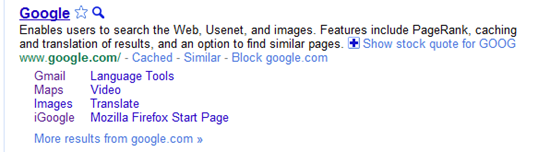
A new and incredibly useful extension has popped up on the Chrome Web Store: Personal Block List (by Google). If you have ever searched for something and been plagued by useless links that wiggle past Google’s algorithm — and odds are you have — then this extension is your friend. Personal Block List adds a handy little “Block [URL]” button to the right of the “Cached” and “Similar” links in Google’s search results. Once clicked, that site is omitted from your search results until you decide otherwise.

Block Sites from Search Results with Personal Block List Extension for Google Chrome, Rockmelt | 40Tech

Neat, huh? Of course, it should be mentioned that this extension will transmit information to Google regarding the sites you have blocked, including patterns that you create as you block or unblock sites. Google promises to only use this information for good and to improve their products. Actually, there are no promises. They just say that you “agree that Google may freely use this information to improve [their] products and services.” Considering all of the things out there that already track browsing habits — including Google — this sort of tracking may actually be a step forward.

In any case, the extension does its job well. In a few of the coding-related searches I have been conducting lately, looking for help on a particular area of menu design, I repeatedly found myself directed, via several different domains, to the same annoying website trying to sell me their tool that was apparently supposed to make my life easier. My annoyance in this regard is no more. The Personal Block List extension for Google Chrome (as well as Chromium, and Rockmelt) works!

If I were to have any issues with the extension, they would be that it does not work from the searchbar, only from the actual Google site, and that it doesn’t appear to have a master list in the cloud. That last surprised me, and meant that I had to block the same site twice, once in Rockmelt, and once in Chrome. Still, it did the job. I can see that there will be many more sites that will end up being forcibly removed from my search results soon.

Try it out the Personal Block List (by Google) Chrome extension here.


Too Many Facebook Friends May Cause Stress, Anxiety

Too Many Facebook Friends May Cause Stress, Anxiety | 40Tech

Having many friends is classically considered a desirable thing, leading to things like wealth of spirit, a good self-image, and a generally happy life. Not so in the modern days of the internet, where terms like “friend” are used as a label for the barest acquaintance, and sometimes even for enemies. In fact, in a recent study by psychologists from Edinburgh Napier University, it was discovered that the amount of “friends” you keep on Facebook may be linked to heightened feelings of anxiety and stress.

Scream image by Robbert van der Steeg

200 students were surveyed, and it was discovered that at least 12% of them felt that Facebook made them anxious. Each of those 12% maintained an average of 117 “friends,” while the remaining 88% kept an average of 75. Some other interesting findings were as follows:

  • Many felt a great pressure to be on Facebook, but there was “considerable ambivalence” as to its benefits.
  • Stress from Facebook use was caused by many different stimuli, including “feelings of exclusion, pressure to be entertaining, paranoia, or envy of others’ lifestyles.”
  • 63% would delay replying to friend requests.
  • 32% felt guilty rejecting friend requests.
  • 10% didn’t like receiving friend requests at all.

The word “friend” could be the main cause of Facebook-related stresses. Perhaps the social media giant should come up with a proprietary name they can trademark, or use something closer to the word “acquaintance” as opposed to a word that is meant to engender feelings of warmth, familiarity, and long term trust. Keeping things as they are, however helps to foster an environment where users, who are still emotionally tied to the meaning of the word friend (no matter how watered down it has become), feel compelled to log on, invite others, and be a part of the service — and maybe more due to its negative aspects instead of the purported positives.

Perhaps we should all just bite the bullet and prune our lists down to our actual friends?

What do you think?

Does Facebook Stress You Out? [WebProNews]


Wi-Fi is Radiation Too

Wi-Fi is Radiation Too | 40Tech

According to a Dutch study, our beloved Wi-Fi — the stuff that large populations of the planet now use in their homes, their workplaces, where they shop, where they drink coffee, and pretty much everywhere else they go — may be killing our trees. Or at least contributing to it. The researchers of Wageningen University say that more analysis is required to reach a solid conclusion on the matter, but so far, it looks like the particular radiation that is Wi-Fi is not at all interested in becoming a tree-hugger.

The tests were done in urban areas, where the high Wi-Fi and mobile phone network concentrations battle it out with other not-so-nice-for-trees elements such as fuel and other particle emissions. This leads to an obvious question about whether the trees’ sickness is more a result of other side-effects of urban sprawl, but the researchers feel they have a pretty good case against Wi-Fi. This is unfortunate, as Wi-Fi has become more and more a part of our daily necessities. Either way, something that is in the air in areas of major and connected human cities is causing the upper and lower layers of leaves to die, leaving behind a “lead-like shine” — and apparently inhibiting the growth of corn cobs.

This news, while not entirely proven true, may mark down one more in an ever-growing list of our human comforts and advancements that may actually be harmful to our immediate environment.

What do you think?

Study: Wi-Fi Makes Our Trees Sick [Read Write Web (via PC World)]