
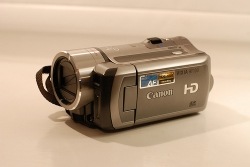
 Camcorder manufacturers are releasing fewer tape-based consumer camcorders each year, in favor of models that record to other digital media, such as flash storage. This is great, right? After all, tape can break, it isn’t as portable, and it is easier to copy a file from a format like a flash storage card to your computer, right? Not so fast. As much as it would seem that new storage media would run circles around tape, tape still has benefits that other storage media can’t yet match. After the break, we’ll explain why, but also discuss why these benefits won’t last. Photo by Joe Shlabotnik.
As an initial disclaimer, I own a tape-based high def camcorder, the Canon VIXIA HV30 (predecessor to the Canon VIXIA HV40). I do not own a tapeless camcorder, and have formed the opinions expressed here through research, and listening to others. I welcome input from anyone who wants to add to the discussion, or question my assertions.
One of the benefits of a tape-based camcorder over a tapeless camcorder is that tape is better for archiving. Some tapeless camcorders record to internal flash or internal hard drives, some record to memory cards, and others record to both. Theoretically, one could use memory cards for archiving, but this would be costly. On the tape side, a Panasonic AY-DVM63PQ costs $2.89 on Amazon, and will get you about an hour’s worth of HDV video at 25 Mbit/s. By comparison, according to CNET, the Canon HF20/HF200 tapeless camcorders will get you 5.5 minutes of recording per gigabyte at 24Mbps bit rate, and 7.8 minutes per gigabyte 17Mbps. A 4 GB Sandisk card will set you back about $7 on Amazon at the time of this writing (although you could spend as much as $24 for a higher end card). It is easy to see how these costs could add up if you were to use storage cards for archiving.
Tapes are so inexpensive, that your original footage is your archive. After you’ve captured the video from the tape to your computer, you put the tape in a secure place and you have your backup. Not so with tapeless camcorders if you’re not going to use the memory card for archiving (and definitely not so with respect to camcorders with internal storage only). You regularly need to offload the video from either the camcorder or memory card, and then make another copy if you want a backup. That backup might be onto a DVD, or perhaps an external hard drive. This extra step somewhat defeats the purpose of the “ease of use” of tapeless camcorders (also, I’ve heard some people report that it actually takes them LONGER to transfer video from their tapeless camcorders than it did from tape-based ones, but this doesn’t seem to be the norm).
Footage from tape-based camcorders is also easier to edit for most people. Tape-based camcorders generally record to HDV format, while tapeless camcorders record to AVCHD format. For now, AVCHD is out of the reach of people with lower end computers, as AVCHD requires much more processing power than HDV. Low end computers simply choke on AVCHD footage.
Many people (me included) favor tape-based camcorders for these reasons. Eventually, though, the major benefits of tape-based camcorders will disappear. Over time, computing power will be less of a concern, as users phase out older machines and replace them with machines that are capable of editing video shot in the AVCHD format. In addition, storage costs are dropping all the time, making it easy to envision a time when flash storage is just as cheap as tape. One concern is that flash media is not yet proven as a reliable long term storage option. Therefore, cautious videographers will likely want to backup their videos onto external drives or other media.
Regardless, the future is coming, and it is a tapeless one. Let’s just hope that tapeless technology and storage technology have improved by then, and that storage costs continue to drop.

robert says:
Great article, I'm waiting for a Canon hv40 and look forward to using tape. I just never felt secure about hard drive storage! The other day in Walmart I saw that they still carry Hi8 tapes , so I bet dv tape will be around for a few more years.
June 12, 2009 — 8:15 am
robert says:
Great article, I'm waiting for a Canon hv40 and look forward to using tape. I just never felt secure about hard drive storage! The other day in Walmart I saw that they still carry Hi8 tapes , so I bet dv tape will be around for a few more years.
June 12, 2009 — 9:15 am
Evan says:
I think you're right. My biggest concern is the low-term viability of flash as an archiving solution. I guess time will tell.
June 13, 2009 — 10:16 am
lto4 sellers says:
I think you absolute right Some tapeless camcorders record to internal flash or internal hard drives.
June 29, 2009 — 8:39 am
Ray says:
You can edit AVCHD on a Mac using iMovie ’11 — after a fashion. This is from the Apple website:
“iMovie ’11 does not edit AVCHD video natively, it instead converts this to AIC (Apple Intermediary Codec).
“This does slow down the importing of video; however, the editing speed is much faster.
“Editing native AVCHD video can be performed by some video editing apps, but the rendering process is much slower.
“This is because AVCHD video records data differently – in order to save space, only pixels which change from one frame to the next are recorded as new frames.
“This enables AVCHD video to take up less space on memory cards and hard drives, but does slow down editing significantly, as the editing app needs to re-render each frame separately, with a full set of pixels per frame.”
August 28, 2011 — 5:42 pm
Evan Kline says:
Thanks, Ray. I’d be curious to see whether any quality is lost in the process.
August 29, 2011 — 10:43 am
kenny dunn says:
I know this article is pretty old, but I just wanted to throw something in there. My mom gave me 8mm film the other day of our childhood (I am 46 now) that she found in a bunch of stuff in storage. We got an old projector and converted them to digital for easy viewing, but how many kids now will be able to find their childhood videos after 40 years that were shot straight to flash? I will only use a tape based for as long as I can.
February 2, 2012 — 8:38 am
Evan Kline says:
Home-ripped DVDs are a problem too, since they degrade over time. I need to get my ripped and copied to another format.
February 3, 2012 — 4:37 pm