While the post title may inspire commentary about the relative brain power of many drivers on the road these days, the video below actually does show a car — a Volkswagen Passat — being steered by only the mind of its driver. No hands, no special voice commands… just brain power.
BrainDriver is a is the mad scheme of Raul Rojas and his colleagues at the Free University of Berlin. It is not intended to be a technology used in general vehicle production, but is more of a proof of concept experiment to show that we can marry the human mind to machines (or to computers that are attached to machines) and control those machines with our thoughts. Control is accomplished by training a computer to read intent via the brain’s output of electromagnetic signals, picked up by an electroencephalography (EEG) headset that was originally developed by Emotiv for gaming (it’s $299 – if’ you’ve tried one, let us know about it).
Intended for future production or not, and even in its rudimentary form, BrainDriver brings all sorts of fun sci-fi applications to mind — especially of the thought-controlled spaceship variety. Forget cars. Bring on the personal starfighters!
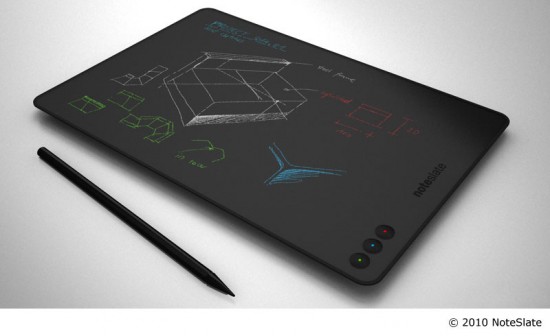
If you’ve always wanted to be done with pen and paper in favor of a comparable digital solution, or are just a fan of nifty one-trick gadgets, then you are going to want to put aside $100 this June for the NoteSlate. NoteSlate is a high tech gadget with low tech dreams; an E-Ink tablet with the sole purpose of doing its best to emulate a notepad — or, more likely, one of those personal chalkboards that is its namesake.
It’s actually a very cool idea. The tablet’s 13-inch screen and stylus combo make for easy note scrawling, diagram drawing, and other scribbles, and the single purpose aspect makes for a comparatively low-priced solution for the pen and paper crowd that want an upgrade that fits their work habits.
The specs of the NoteSlate are intriguing, as a few of them fly directly in the face of the MORE POWER mantra of most of today’s devices. Check out some of the highlights below:
750×1080 pixel display that outputs at 100ppi
1bit colour
No antialiasing — they claim this is their best feature
Optional WiFi (it’s free to add it in, apparently)
No web browsing (though there is some sort of sharing client)
It does have some of the more standard things you might expect from a modern tablet, however, such as its slick look and extremely light weight, a mini-USB port, SD card slot that supports up to 32GB, and mp3/PDF/OCR capability (another free upgrade). It also bears mentioning that the hardware and software are both open source, and that you can get a few different single-colour models, and even a four-colour model to suit your personal tastes.
It is unclear how well the NoteSlate will do in the burgeoning tablet market, but it definitely does speak to a niche of more hands-on, note takers, especially those with a more minimalist bent.
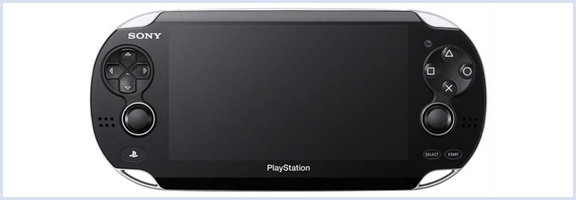
If you haven’t already heard about Sony’s PSP 2, codenamed Next Generation Portable (NGP), then you are in for a treat! The NGP features power enough to rival the Playstation 3 — and that’s not just fluffy marketing-speak. The specs of this little beast are off the charts.
Read on for a rundown of what’s included, and a NGP gameplay video of Uncharted.
The Sony PSP2 (NGP) includes the following:
Quad-core ARM Cortex A9 processor
Power VR SGX534MP4+ GPU (also apparently quad-core)
6-Axis motion sensing system (gyroscope/accelerometer — and a compass too)
Front and rear cameras
WiFi, Bluetooth, 3G and GPS
New, vertically paging interface
Fancy new media storage system for games (which are downloadable, only)
And all of the other stuff you expect from a PSP.
Sony obviously plans to swing hard for the mobile gaming system title. Some people have already pointed out that they skipped the 3D craze here, but that doesn’t mean that they aren’t planning another model with 3D capability. In fact, it is highly possible that there will be multiple versions of the NGP available at different price points when it launches later this year (that’s what I said… later this year). A wifi-only version has been mentioned, for example, and it is likely that there will be other features that might be considered premium and affect the overall price point.
On that, Sony is still being rather hush-hush about how much this little beauty will cost, saying only that “It’s not going to be $599,” and that they “will shoot for an affordable price that’s appropriate for the handheld gaming space.” (Engadget)
PSOne games will be available for download on the PSP2, and downloaded PSP titles will be playable as well — seems you’re out of luck if you have a lot of UMD games, though. Either way, my white, Darth Vader emblazoned PSP 2000 is probably going up for sale, and soon!
Every now and then an innovation comes along that can change the world. If you thought flying cars were cool, or that phones that can translate languages on the fly were cutting edge, you haven’t see anything yet. A Washington state startup company has invented the “Bottom’s Up Draft Beer Dispensing System.” While such an invention might not be “tech” in the way that we normally think of it, we can’t pass up a chance to write about this one. Read more
CES 2011 wrapped up about a week past, and from the the look of things, there is some pretty sweet new tech on the horizon. There are tablets, smartphone/laptop combos, tablet/netbook combos, concept cars/bikes, connected TVs, WiFi-connected refrigerators, unifying cloud storage services, and much much more.
After the jump, I’ve listed three of the things I’m most looking forward to, as well as links to a few articles from folks who were at the event. Have a read, be tantalized and amazed — and let us know what you are most excited about in the world of tech and gadgets this year!
Motorola Xoom
There’s a reason this year is being heralded as the year of the tablet — and there’s a reason that this tablet stole the entire show. Motorola’s Xoom tablet was the only one at the show using the new, optimized-for-tablets Android Honeycomb. It’s packing a 10.1 inch display, 1280×800 resolution, 1GHz dual-core Tegra 2 processor, and front and rear cameras. It’s ridiculously fast, can take 720p video, and will have 4G capability in the second quarter of the year.
There’s no word on the price of this beauty, but it ought to give the iPad — possibly even the iPad 2 — a serious run for its money. Just the fact that it has all that power, supports Flash, and is on a network other than AT&T (Verizon) might be enough to sway some users. It is unknown whether there will be a WiFi-only version or not, or if anyone outside of Verizon will get a hold of it — but I hope that Motorola would be smart enough not to limit themselves.
Motorola Atrix 4G
Motorola came to win at CES this year, and their smartphone offering is, in a word, awesome! I own an iPhone and an iPad, and I thoroughly enjoy them both, but the geek in me is loving what companies like this are doing with Android. The phone itself is beefy (the dual-core Tegra 2 chip and 1GB of ram make playing 1080p video and Flash a breeze), but the coolest thing about it is the dock — which turns it into a laptop.
Seriously.
The phone just plugs into the back of the 2.4 pound laptop dock, and voila! You get an 11.6 inch screen with a compressed keyboard, a trackpad, and webtop software that lets you surf the full-sized web, even picking up where you left off on the phone. You can also access the phone’s interface, and run its apps in full screen. According to LaptopMag, you can even run Citrix Receiver, which allows you to basically run full Windows right there on the machine.
Very cool!
Real Networks Unifi: One Cloud Service to Rule Them All
Real Networks is coming out with a cloud service to combine all cloud services. Unifi will allow you to aggregate your multimedia files — or whatever files — that are on multiple devices and online services. This would allow you to keep just one central online media and file library to organize, manage, and access all of your stuff. Its incredibly convenient, especially as we are moving more and more to the cloud. The interface looks pretty good, too.
Apparently, Unifi will be open for public beta in a couple of months, and Real Networks plans to offer the standard freemium model: 2GB of storage for free, with paid plans that climb up to 100GB. iOS and Android apps should be available around the same time as the beta lanch, with Windows Mobile 7 and Blackberry apps to follow. It ought to be useful for Google Chrome OS when it finally goes live, as well.
So those are the things that really stood out to me in CES 2011, but there were many, many more — good, bad, and weird. Here are a few links: