

- Easy Access to US, UK Streaming Services From Anywhere - August 18, 2012
- 5 Fresh Android Games Released in 2012 - July 5, 2012
- Google Chrome Explodes On To iOS, Puts Desktop Experience In Your Pocket - June 30, 2012
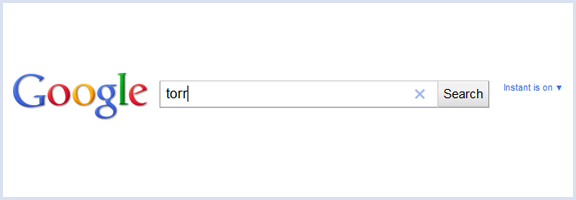
In December of 2010, Google announced that it was planning to make “copyright work better online.” One of those steps was to remove “terms that are closely associated with piracy” from autocompletes, making it slightly more difficult for those looking for ways to find less than legit files to use their service. It seems that Google has made good on its promise, removing several search terms — and portions of search terms — from both autocomplete and Google Instant.
While some may cheer this move on Google’s part, there are several parties who are finding this censorship to be unfair. 40Tech has taken an anti-piracy stance on more than one occasion, but we are also not fans of censorship. Companies like RapidShare, Megaupload, and BitTorrent are most definitely used by those participating in shady file-sharing, but they are also used for legitimate, and often useful, purposes, yet these sites can no longer be found via Google’s autocomplete or Instant features. Is it fair that they be given selective treatment when, as a representative of RapidShare states: “A search engine’s results should reflect the users’ interests and not Google’s or anybody else’s?”
The selection of banned terms seems to be arbitrary, as not all well-known torrent sites are affected — you can still find The Pirate Bay, for instance. Anything using the search term “torr,” however, has been removed, along with several other terms and bits of terms. This is unfortunate for anyone doing some quick research on the torr symbol (a non-SI unit of pressure), or the high-IQ society Torr.org, or Torr the thin film and nanotechnology company, or anyone with the last name of Torr — which shows that Google’s approach is somewhat less than perfect.

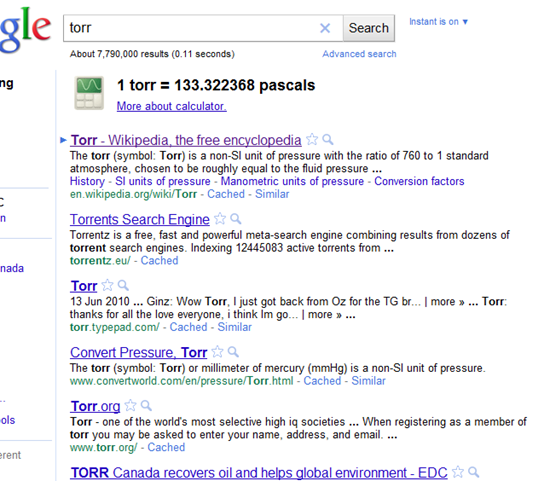

Image from TorrentFreak
At this point, only autocomplete and Instant are affected. You can still find whatever you might be looking for when you press enter — but good luck if you are looking for something legitimate that incorporates one of Google’s banned terms and are hoping for some suggested results.
What do you think of Google’s approach here? Is it a good thing — or is it yet another form of relatively pointless censorship? Will making torrents a little bit harder to search for on Google actually have any impact on piracy at all? Let us know in the comments.
Google Starts To Censor Torrent-Related Search Queries [ReadWriteWeb]

Kosmo @ The Soap Boxers says:
“One of those steps was to remove “terms that are closely associated with piracy” from autocompletes”
I’d like to point out the fact that “parley” still pops up.
“a representative of RapidShare states: ‘A search engine’s results should reflect the users’ interests and not Google’s or anybody else’s?'”
I’m not sure I agree with this. Who are we to tell a private company what their product should do? It would be in the customer’s interest (mine) for their to be a steak buffet at Outback … but I don’t get to make decisions for a private company.
Having said that, it is in the best interests of Google to provide the search results their users want. And I’m not fan of censorship.
January 28, 2011 — 9:16 am
Bobby Travis says:
I hear what you’re saying Kosmo. For me the issue is definitely more on the point of censorship. Unless it’s me censoring what my kid can look at, then I don’t really care for it. Consenting adults should be able to search for whatever they like.
I’d be more in favour of Google providing more robust parental controls than anything else.
January 28, 2011 — 11:41 pm
Anthony Russo says:
I think it is a good move by Google. It’s like the people that worry too much about the 1% that will use your info for nefarious purposes so lets not share any info. (Most of your info is just used for targeting marketing…oh no!)
Most of the people that are affected here would be the ones searching for piracy and thats fine to let them be affected. That’s the point. The few others will have to just hit Enter…oh no!
Anthony
January 28, 2011 — 11:04 am
Bobby Travis says:
I don’t know, Anthony. I think that the people who come up in the instant results for portions and mys-types of some of those words, especially businesses, might have a serious problem with what Google has done. I don’t like it, myself — though it’s more about the principle of the thing for me — but I think that if Google is going to go this route, they should be more specific about what is being blocked.
January 28, 2011 — 11:45 pm
Ali Mujtaba says:
Although piracy is bad, censorship is also bad, people need to feel free.
January 28, 2011 — 8:34 pm
Bobby Travis says:
Word.
January 28, 2011 — 11:45 pm
Maria Pavel says:
Hello,
This is just … wow.. A very hard strike from Google towards piracy, it won’t stop it but it will make it grow with fury in my opinion. Not even Google can stop piracy but it slower it’s progress. I guess Google will continue doing these anti-piracy acts but in vain.. However, congratulations to you for sharing this great article and for Google for the funny attempt of fighting piracy.
Best regards,
Maria
January 28, 2011 — 9:27 pm
Bobby Travis says:
Glad you enjoyed it Maria!
January 28, 2011 — 11:46 pm