
 Are you like me, and get frustrated when one of your gadgets doesn’t work to perfection? It is easy to forget just how far we’ve come. Technology advances at a breakneck speed. The gadgets and gizmos in our lives change drastically from month to month, let alone from year to year. An earlier comment by one of our readers, Jim Saul, got me wondering what tech was like in the year I was born, 1968, compared to today. Read on to see what I discovered.
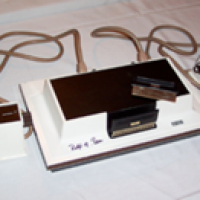
Magnavox Odyssey photo from Martin Goldberg and Electronic Entertainment Museum (E2M), via Wgungfu at en.wikipedia
Internet
The Internet is perhaps the greatest tech development in our lifetime. Can you imagine life without the Internet? In 1968, something resembling the Internet was only a concept. ARPANET was created by the United States Department of Defense, and, according to Wikipedia, was "the world’s first operational packet switching network, and the predecessor of the contemporary global Internet." ARPANET had been conceptualized years before, but sent its first transmission on October 29, 1969. The first permanent connection was made on November 21, 1969. ARPANET initially connected four U.S. universities, with several others joining in the months and years thereafter. And it wasn’t until the Nineties that the Internet began to resemble what it is today, with the development of the hypertext protocol for the World Wide Web, and the development of Mosaic, the first graphical browser. Compuserve, the first commercial online service, was founded in 1969.
Video Game Consoles
My first memory of an in-home video game was a Pong console. The console contained several games, but they were all a variation on the same theme. The games consisted of one or more "balls" (that were actually square), and one or more "paddles" (that were actually just solid lines on the screen). The object was to get the ball past your opponent, and into the goal.
Pong, though, was not released until 1975. The Magnavox Odyssey predated Pong, having been released in 1972. What about 1968? Nothing. That’s far cry from the choices we have today, between the Playstation 3, Wii, and Xbox 360, not to mention handheld gaming units.
Computers
As you might guess, computers have advanced by leaps and bounds over the last 40 years. Today, Intel sells a Core i7 processor with 4 cores and 8 threads, with up to a 3.33 GHz clock speed. Back in 1968, Intel was just being founded. During that year, Data General Corp. introduced the Nova, a computer that sported a whopping 32 kilobytes of memory, and sold for $8,000. The computer that guided the lunar module to the moon was introduced in 1968.
Mobile phones
Although there is no absolute consensus on who created the first cellular phone, most sources suggest that the first cellular telephone call was placed in 1973 by Martin Cooper of Motorola, and that cell phones didn’t become available to the public until 1984. So, if you were looking for a mobile telephone in 1968, you were out of luck. That’s a far cry from today’s landscape, where a consumer can be overwhelmed by all of the choices, from a simple mobile phone, to smartphones that are more powerful than computers of only a few years ago. Google’s Nexus One sports a 1 GHz processor, and 512 MB of RAM. I have a computer in my house (admittedly collecting dust) with lower specs than that.
Music formats
Ah, 8-tracks. Back in 1968, consumers could purchase music in two main formats – vinyl records, and 8-track. An 8-track was a single reel of tape, connected into a continuous loop. The sound quality was bad, but 8-tracks were portable. For better quality, consumers listened to music on vinyl records in their homes. Both vinyl records and 8-tracks were types of analog media. Today, everything is digital. We’ve shot past compact discs and cassette tapes, to a world of audio files in MP3 and AAC format. Our music is now more portable than ever, and, being digital, capable of being copied without any loss of quality. Of course, that has ushered in new headaches for a recording industry that has been slow to adapt to new technology.
Home video format
When I was growing up, we watched Hollywood movies at home, on VHS tapes. VHS had defeated Betamax in the videotape format wars. But VHS and Betamax didn’t exist until the 1970s. Before that, including in 1968, consumers didn’t typically watch commercial movies at home. Today, we’ve experienced another format war, with Blu-ray prevailing over HD DVD. But Blu-ray’s success may be short-lived, as digital downloads gain steam. Between iTunes, Netflix, and Amazon, coupled with ever increasing internet speeds, the future points to a world without physical copies of home movies.
Television
Today, high definition televisions are becoming the norm. In 1968, color television was just becoming commonplace. Color television had been introduced in the United States in the 1950s, but high prices and a lack of broadcast material prevented color television from becoming standard until the 1970s. What’s next for television? If the industry has its way, get ready for 3D television, in your home.
From a content perspective, 1968 saw the first live network transmission of video from inside a manned orbiting U.S. space capsule. 60 Minutes and One Life to Live also debuted in 1968. In 1968, viewers could choose from a small handful of stations. Today, viewers have an abundance of choices, with over 20 nationwide broadcast networks, and even more niche channels.
What was the world of tech like when you were born? What changes in technology strike you as the most extreme?
Sources:
Computer Hope, Computer History, 1960-1980
Wikipedia: History of the Internet, and ARPANET
A Brief History of the Internet, from Walt Howe’s Internet Learning Center
Wikipedia, Video Game Consoles
A Brief History of the Home Video Game Consoles
Computer Hope, Computer History, 1960-1980
Intel Core i7 information page
Cell Phone History, from Oracle ThinkQuest
The History of Cell Phones, from TheHistoryOf.net
Cell Phone History, from Cellphones.org
A Brief History of Audio Formats, by MP3Developments
From Vinyl To Free – A History Of Music Formats (and How Much They Have Cost), by Donald Bunuel, on Amog.com
Videotape, Wikipedia
3D TV: Is the World Really Ready to Upgrade?, by Scott Steinberg , Digital Trends
Color Television, Wikipedia
List of Years in Television, Wikipedia
List of United States over-the-air television networks, Wikipedia


Kosmo @ The Casual Observer says:
What cracks me up is when DVDs are marketing as containing a “digital version” of the movie.
What, the DVD version is analog or something? :) Seems that digital has come to mean “something that you can play on your computer, ipod, etc” rather than the true meaning of the word.
I was born in 1975, but we had an 8 track player with several Kenny Rogers albums. I still remember my parents buying their first microwave. That sucker lasted like 20 years.
.-= Kosmo @ The Casual Observer´s last blog ..Should College Athletes Be Paid? =-.
March 7, 2010 — 10:45 pm
Bobby Travis says:
I’m with Kosmo… on all counts. Even the 8 track man. We had LPs too. I grooved to many an LP as a kid.
March 9, 2010 — 9:08 pm
Bobby Travis says:
Oooh! We also had a Coleco Vision!! I miss Zaxxon, man!
March 9, 2010 — 9:09 pm
Evan Kline says:
You guys remember Intellivision? I had the Atari 2600, but a buddy of mine had that one. I remember loving bi-planes. Controller was goofy, but we played those games for days and days.
March 9, 2010 — 10:09 pm
Bobby Travis says:
Heh — I remember. Coleco’s controllers looked like weird telephones. Those were the days though! When you could wrap the score on Donkey Kong or Zaxxon back to zero — and game were actually hard and had no save points!
March 10, 2010 — 3:53 am
Bobby Travis says:
And who here remembers the satellite dish and descramblers? :D
March 10, 2010 — 3:53 am
Evan Kline says:
I remember seeing the big old satellite dishes (aka the state flower of West Virginia), but we never had one. I also remember the days of descramblers on cable boxes (not that we ever had one or anything).
March 10, 2010 — 7:14 pm
Daniel Asante says:
How old are you guys by the way? I’m way too young to know of any of this stuff.
April 28, 2015 — 12:19 am
Evan Kline says:
I’m the grand old age of 46, Daniel . . .
April 28, 2015 — 7:10 am