All companies swing and miss from time to time. Apple, which seemingly can do no wrong, had its Pippin and Lisa. Microsoft has had its share of flops, too. Money.co.uk recently took a look at 10 of them.
Some of the choices are obvious, like Windows ME and the Kin. Some are obscure, like ActiMates (a creepy children’s toy). Missing from the list is Windows Vista, which has been the object of much scorn.
What’s number 1 on the list? I’ll give you a hint. He had big bubble-shaped eyeballs, and was integrated into Microsoft Office. Remember Clippy?
For the rest of the list, head on over to the source.
Is there anything missing from the list? Do you see anything on the list that shouldn’t be?
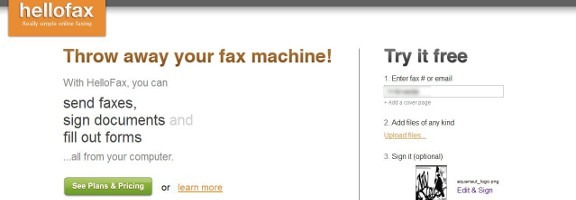
With the dominance of email and other forms of digital communications, the fax machine is dying a slow death. There are still times, though, where you’ll want to not only send a fax, but attach a signature to a faxed document. You can do so without a scanner, fax machine, or printer, using webapp HelloFax. HelloFax also supports the signing and sending of documents via email.
With HelloFax, you upload your document (so be forewarned if privacy is an issue) and enter the recipient’s fax number or email address. If you’d like, you can also add a signature or other marking to the document that you’re sending. The option box for this will appear after you’ve uploaded your document.
You have the choice of creating your signature with your mouse (probably quite difficult), uploading an image, or by taking a photo of your signature with your phone. HelloFax will process that, and isolate it for you. You can crop the signature image, as well as adjust the contrast. The background of this image will be transparent, so you don’t have to worry about it accidentally obscuring parts of your document. I found that my signature looked horrible by default, but I was able with to get it looking nice with just a bit of tweaking.
When you’re all done, just hit send, and your message will be sent. HelloFax allows you to send five faxed pages for free. After that, you need a paid account, which begins at $4.99 per month for 50 faxed pages. The sending of signed emails is unlimited.
How do you send faxed documents, if you don’t have a fax machine?
Use labels, such as those offered by Gmail, to tag every message with one or more labels;
Use folders, as offered by traditional email clients and providers, to place each message into a single, distinct folder;
Archive all of your messages into one place, and just use the search functionality of your email client to find your messages; or
A combination of the above methods.
I’ve used labels ever since switching to Gmail years ago, and have several filters set up to automatically label a large percentage of incoming messages. Lately, though, I’ve been wondering if it is really necessary. Gmail’s search capabilities are very powerful, and taking the time to label every message can be time consuming. At the very least, I think I can slim my labels down to a few broad categories.
What method do you use to organize your email? Is it one of the methods listed above, or do you have your own way of doing things?
If you like tech and have something to say about it, we want to hear from you! We’re always looking for new points of view at 40Tech — that’s why we got into this blogging thing in the first place; to share our thoughts, maybe help some people out, and hear what you have to say about it all.
We’ve had some fantastic guest posts from a few of our regulars, recently, and we would love to have enough to feature at least one of you every week. Hell, if you want more exposure to the wonderful world of the web, and maybe the opportunity to chat with the the folks who created some of your favourite software, you might even want to aim for a regular writing gig with us. We can’t pay you, of course — this is a hobby blog man! — but we get good search engine love and have a blast hanging out with our awesome readers.
If you want to write for us, we want to chat with you! Take a read over our guidelines, and get in touch!
I recently read a Gizmodo article about BitCoin, a new digital currency that is peer-exchanged — and generated — and aims to “revolutionize global finance.” It’s a nice idea, really, and some stores and services have already adopted it. According to Gizmodo, you can already trade BitCoin tokens for web designers, games, guns, and even drugs — yep… drugs. This sounds like the makings of real money to me, but how far will it — or can it — go?
Money is many things: the root of all evil, maker of spinning worlds, an absolute necessity to live in our society, yada yada. It also has a basis on which to trade — generally gold and silver repositories that give the coins and paper some degree of relative worth. Even our debit and credit cards, which are the primary ways of buying things digitally, are tied up in the worldwide economy of shiny valuable metals. This has been going on for thousands of years, ever since a few people decided that hoarding pretty things was a good way to live — and other people decided they wanted those same pretty things too. In a nutshell, anyway.
Can BitCoin stack up against all of that? It creates itself out of nothing! It’s an app on your computer that uses your machine to crowdsource the power to facilitate the currency’s transactions, all the while generating tiny bits of BitCoins for you. The creators have put some thought into it, sure, putting a cap on the creation of BitCoins (21 million in total) that will introduce scarcity, and therefore a basis for value, but what kind of potential does this new currency have against thousands of years of history? Not to mention that the wheels that turn the economy, like credit card companies, might have a thing or two to say on the matter – especially about the lower of fees, transaction limits, country walls, and other things that provide financial control over users.
I think BitCoin is a nice idea. I think it even has potential — at least to gain some sort of reasonable adoption over the long term. It will probably be a very long term, though, before any real revolution is seen. Everything we do is too tied up in regular currency. There are those out there who believe in BitCoin now, however — and they are trading the online currency at one BitCoin for $7.50. That’s virtual coins for real money — and not bought by someone who is looking to get a new castle or set of armour in their favourite MMORPG.
Think about it.
Is BitCoin revolutionary? Doomed to failure? Ahead of its time? — Or maybe all of the above? Let us know what you think in the comments.




BitCoin Digital Currency: Financial Revolution or Doomed to Fail?
I recently read a Gizmodo article about BitCoin, a new digital currency that is peer-exchanged — and generated — and aims to “revolutionize global finance.” It’s a nice idea, really, and some stores and services have already adopted it. According to Gizmodo, you can already trade BitCoin tokens for web designers, games, guns, and even drugs — yep… drugs. This sounds like the makings of real money to me, but how far will it — or can it — go?
Money is many things: the root of all evil, maker of spinning worlds, an absolute necessity to live in our society, yada yada. It also has a basis on which to trade — generally gold and silver repositories that give the coins and paper some degree of relative worth. Even our debit and credit cards, which are the primary ways of buying things digitally, are tied up in the worldwide economy of shiny valuable metals. This has been going on for thousands of years, ever since a few people decided that hoarding pretty things was a good way to live — and other people decided they wanted those same pretty things too. In a nutshell, anyway.
Can BitCoin stack up against all of that? It creates itself out of nothing! It’s an app on your computer that uses your machine to crowdsource the power to facilitate the currency’s transactions, all the while generating tiny bits of BitCoins for you. The creators have put some thought into it, sure, putting a cap on the creation of BitCoins (21 million in total) that will introduce scarcity, and therefore a basis for value, but what kind of potential does this new currency have against thousands of years of history? Not to mention that the wheels that turn the economy, like credit card companies, might have a thing or two to say on the matter – especially about the lower of fees, transaction limits, country walls, and other things that provide financial control over users.
I think BitCoin is a nice idea. I think it even has potential — at least to gain some sort of reasonable adoption over the long term. It will probably be a very long term, though, before any real revolution is seen. Everything we do is too tied up in regular currency. There are those out there who believe in BitCoin now, however — and they are trading the online currency at one BitCoin for $7.50. That’s virtual coins for real money — and not bought by someone who is looking to get a new castle or set of armour in their favourite MMORPG.
Think about it.
Is BitCoin revolutionary? Doomed to failure? Ahead of its time? — Or maybe all of the above? Let us know what you think in the comments.
What is BitCoin [Gizmodo]