![App of the Week: Move2Picasa [Chrome] | 40Tech](https://www.40tech.com/wp-content/uploads/2011/07/image4.png "App of the Week: Move2Picasa [Chrome] | 40Tech")
Our last post on Google+ was a question on what you thought of the hype surrounding it. We’ve had a chance to play with it now, and so have many of you — and all in all, we like it. That’s not what this post is about though. This post is about taking advantage of Google opening up unlimited storage in Picasa as a result of Google Plus, and how you can use that, and a handy migration tool called Move2Picasa to backup your Facebook photos — whether you plan to use Google’s new social network or not.
UPDATE: The creator of Move2Picasa has changed the URL to the Chrome extension (the correct one is now in the post), and has changed the name of the Move2Picasa extension to Move Your Photos. Thanks to Peter Pawlak on Plus for catching that!
Note on Unlimited Storage: Google has opened up storage in Picasa, in general. Plus users have free, unlimited storage for photos that are a maximum resolution of 2048X2048 pixels (and videos that are a maximum of 15 minutes), and 1GB of free storage for larger resolution photos. Anything over the 1GB (or whatever you have paid for additional storage) will be automatically resized down to the maximum free resolution. Non-Plus users get basically the same service, but their maximum resolution for photos is only 800X800 pixels.
Move2Picasa started as a website-based tool put together by Aman Kumar Jain, a web developer from Pune, India. It was leapt upon immediately by many of the early adopters of Plus, and the servers were quickly overloaded to the point that the site wouldn’t even load. Aman worked to solve the issues, and has now migrated Move2Picasa to a Google Chrome Extension .
The extension works beautifully! I copied over 1600 photos from Facebook to Picasa in less than an hour, and I barely had to lift a finger.
Here’s how it works:
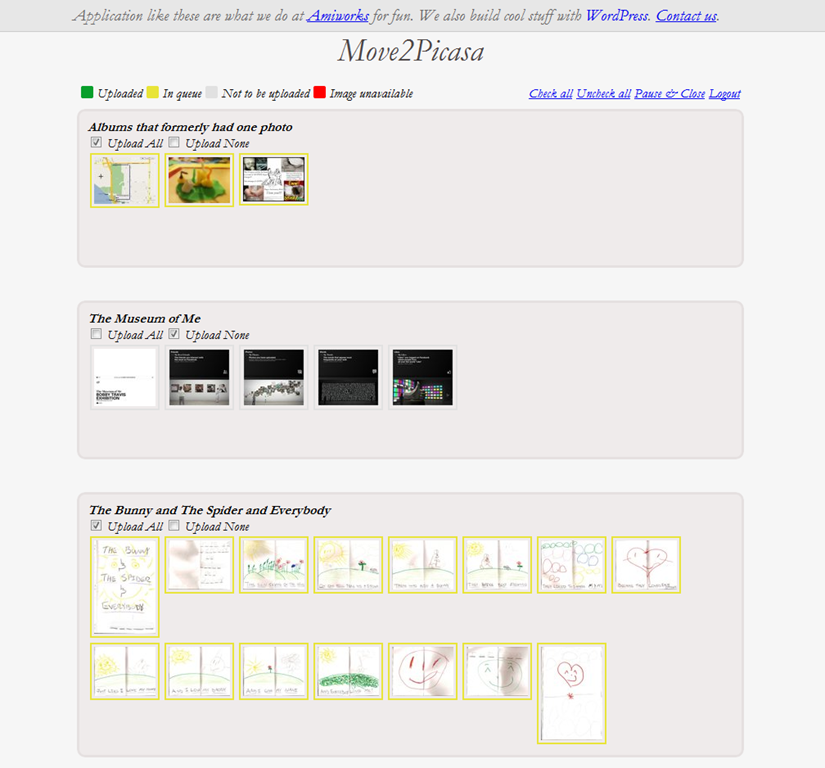
After installing the extension from the Web Store, click on it to log in to Facebook. You will be presented with a page that, after a minor load time, has all of your Facebook photos broken down into albums. The top left of the page shows a legend that identifies the coloured boxes surrounding the photos, which are yellow for “In queue,” by default. The top right of the page provides some simple tools to select or deselect all, pause and close to come back later, and to logout from the tool completely.
Each album has check boxes directly below the album name that allows you to make quick choices to Upload All or Upload None of the photos of that album. You can also click on individual photos to select or deselect them for uploading, which is handy, because you may have certain photos that you want to weed out before they are copied to Picasa. Like the yellow boxes, Upload All is selected by default.
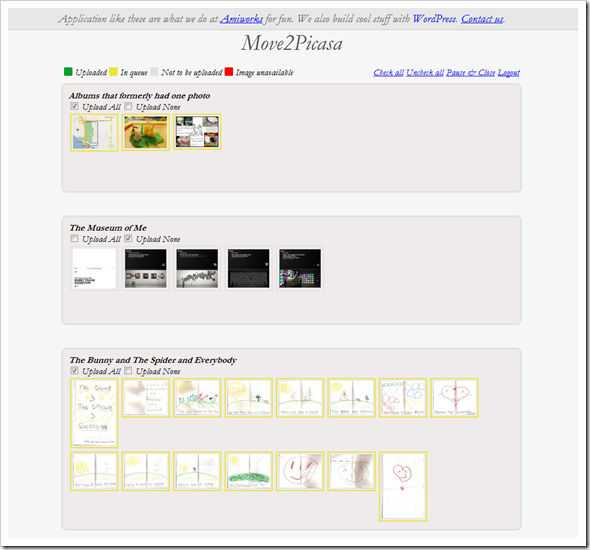
NOTE: At this point you may notice one weirdness: some of your albums may not be showing any pictures. Don’t panic. This is either because there are no pictures in that album, or because the albums have only one photo. Hopefully, this minor bug will be fixed soon — in the meantime, you may want to head to Facebook and add those errant solo photos to a combined album (you may have to log out and log back in to Move2Picasa to see the changes), or simply download them manually from Facebook and upload them to Picasa without the tool.
Once you have chosen the photos you want to copy over to Picasa, click the Upload button on the bottom of the page, and sit back and let Move2Picasa do all the heavy lifting for you!
When I did it, I didn’t notice any extra load on my computer, and had no problem doing whatever else I needed to do while it ran in the background. Some people have reported the occasional error pop-up that breaks the operation (this happened to me, too), but Aman posted to my thread on Google+ (find me here, we can add each other to our respective circles and you can read it) that the issue had been fixed. It was barely a problem, in any case, as all I and the other users who had the problem needed to do was click the upload button again, and the handy countdown picked up right where it had left off.
Before you know it, you will have complete duplicates of your Facebook albums living in Picasa, ready to do with as you please. The only caveats I have discovered so far is that the images appear to be the Facebook-resized versions only, as opposed to the full-res photos Facebook supports now (though I would love for someone to confirm otherwise), and that Move2Picasa does not support caption importing. That last bit is too bad, but hopefully will change at some point in the future. Move2Picasa as a Chrome Extension is only a couple of days old, after all.
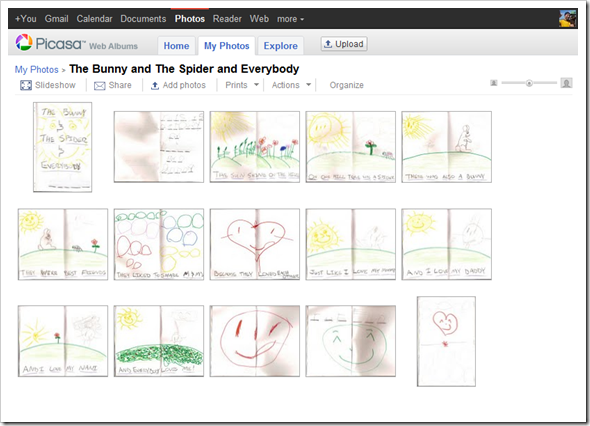
Why Bother?
Some of you may wonder why you should care. You may have no use for Google+, or Plus, or whatever people want to call it, and think that it is just another hyped Google product that will crash and burn. And it might; you never know. The fact that Plus has already surpassed 10 million users (though many are probably not active — but then, neither are bulk of Facebook’s hundreds of millions) indicates otherwise, however. The efforts that Google is putting into design and to integrate Plus into its overall offerings — possibly making it the connecting flagship of Google’s main products — is another strong reason to think Google+ may be around for a while yet.
Whichever way Google’s social efforts go this time, it is unlikely Picasa is going to fizzle away anytime soon. Take it from someone who lost the entire first year of photos with the lovely lady who is now my wife (due to a backup hard drive falling off of a bloody coffee table!), it never hurts to have another backup of your precious photos. The fact that this is an online backup with practically unlimited storage, an interface that allows easy viewing and sharing, and a built-in photo editor doesn’t hurt either. So why not use it?
If you still don’t want any part of Plus, Picasa does offer unlimited storage for everyone, now, but, as mentioned in the note at the beginning of the article, you will only be allowed to upload photos that are 800X800 pixel resolution, as opposed to the 2048X2048 resolution offered to Plus users. If you go that route, though, I’m not entirely sure Move2Picasa will work for you. I don’t see why it wouldn’t, but I haven’t tried it that way. Why would I? Whether I stick with Google+ or not, I’m definitely ok with having dust bunnies swarm over my account if the trade off is the unlimited storage and backup of higher resolution photos.
How about you?



The Future of Technology, Facebook, and Relativity
Do you remember when cell phones were for rich people? It’s only a short jump in my memory to the day when a homeless kid got angry at me when I told him I didn’t have any change; convinced I must be lying because I was carrying a mobile phone. You know, back when they still kind of looked like phones, and Nokia was king? I felt bad for the guy, but I really was broke. I got the cell phone on credit, could barely pay for the bill, and was having many a fight with the company over false charges.
This ramble isn’t to point out that cell phone companies were crooks, even back then, and it’s not to talk about my questionable technology-money choices. The point is that this was only a few years back. I was in my early 20’s — I’m only in my mid-30’s now — and have gone from having no computer, an unused email address, and the blissful (and retrospective) peace of not knowing or caring where people were or what they were doing, to being a geek tech-blogger that makes his living in online marketing and communications. I own an iPhone, my hold-out wife has finally gotten an Android, and my three-year-old owns my iPad — and regularly sends me artwork via email.
Tech is Hungry
Technology is now in the palms of tiny little hands. It’s affordable, or at least readily available, to the majority of the planet, and it’s entire weight of purpose seems to be to interconnect everyone and everything as fast and as in depth as possible. The flow of information has reached truly epic proportions, as has the ability and desire to track that flow, along the habits of the people drowning in it.
The technology behind this phenomenon feeds upon itself, and in many cases, it exists only to further itself. Some of the biggest blogs out there are only so popular because people need a filter; a place to better understand, control, and find some sense of order in the massive technology machine — redundant as that phrase may seem. Smaller blogs exist for the same reason. It was likely part of why Evan started 40Tech, why I joined him, and why you are reading this post right now.
Facebook
Facebook is a prime example of the direction of technology. It’s sole purpose is to become familiar and intricately entwined with as much of your life as possible. It attempts to augment your life; make it easier, faster, more connected. It’s addictive. Facebook is so successful at this that it has become embedded in the general populace to the extent that it can almost be perceived in the same way as a governing body. It creates rules that dictate our way of life, is an easy target for privacy concerns and conspiracy theories, and the smallest changes can lead to virtual revolt and widespread public outcry. Facebook, much like many of the governments out there, projects an image of a body that wants to further mankind; make the world we live in a better place and all that. And like many governments, it’s more than a bit of a stretch for most people to really believe that’s true.
Facebook isn’t going anywhere, either — not without a scandal that shakes the entire foundation of their business to the core, or a hostile takeover by a frightened government or technological superpower. With some of the things in the media regarding questionable privacy practices and the rapid expansion of Google+, those things may not seem so far-fetched, but even if the big bad were to happen to the social media giant, it would probably just morph, as opposed to vanish.
Social connectivity is a way of life for us now; whether we like it or not, and no matter the anxiety, stress, or fun disorders it could cause or amplify. It appeals to the voyeur in us. It allows us to meet people we would otherwise never meet, and keep in touch with people to a degree that would be impossible without it. It is a part of work, school, play, business, entertainment, and everyday, mundane life. For Pete’s sake, your washing machine can already contact you to let you know your laundry is done, and there are tweeting dog collars, man!
Bring on the Microchips!
Over the next 10-20 years, unless the “social media bubble” or end of days people are right, we will likely find ourselves micro-chipped, QR-coded, and surfing the web while jogging with augmented reality sunglasses that also allow us to huddle with our families, friends, or business contacts on GoogleBook. Don’t ask me how they will take our video — somebody else will figure that out, I’m sure. That is, of course, unless we are all suffering from wifi, cellular, and bluetooth radiation poisoning, which could bring the world to a screeching and potentially catastrophic halt that would make Y2K fears look like a happy day at the park.
Or maybe we’ll be busy ripping the fabric of the universe apart with time machines. Did you hear that Albert Einstein may have been wrong? Some scientists at CERN, near Geneva, may have just recorded neutrinos that were travelling faster than the speed of light. That might disprove the Theory of Relativity and screw up one of the major fundamentals of modern physics. Learned that on Google+, I did… And I’ll be sharing it on Facebook, too.