Menu Close

Archives (page 84 of 199)

Follow the 40Tech Writers on Google+, Twitter, and Elsewhere for More Tips and Links

bobby travis on twitter

We know that you can’t get enough of us. That’s what we like to tell ourselves, at least. If you like what you read here, then your tastes might overlap with ours. In addition to what we post here, we post links and tips of other items of interest at a few other places around the web. Here are some links to where else you can find us online.

Read more


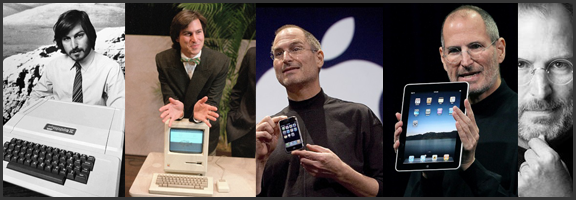
A Short Memoriam to Steve Jobs

A Short Memoriam to Steve Jobs | 40Tech

Steve Jobs was an innovator, a forward thinker, and an incredible entrepreneur. He took no prisoners in the battle with his competition and wasn’t afraid to make fun of them, belittle them, or otherwise express his opinion. He used that persona to help create a sense of elitism and superior quality around Apple products that catapulted the brand to wild success – a success only strengthened by the fact that the quality of Apple products often was superior.

Steve Jobs used all of his forceful personality to do what forceful personalities should do: change the world. Love him or hate him, without Steve Jobs the world as we know it would be a very different place. The man is responsible, on some level, for the computer, tablet, or smartphone you’re reading this on, for the mouse that you use to navigate your PC, and for changing the face of the music industry. And that’s just for starters.

I’m not going to bore you by reiterating what thousands of other blogs have already said. I just wanted to take a moment to express my respect for the man who helped define how I spend my life. He was no angel, and he might well have been a little crazy — but as he himself said:

Here’s to the crazy ones, the misfits, the rebels, the troublemakers, the round pegs in the square holes… the ones who see things differently — they’re not fond of rules… You can quote them, disagree with them, glorify or vilify them, but the only thing you can’t do is ignore them because they change things… they push the human race forward, and while some may see them as the crazy ones, we see genius, because the ones who are crazy enough to think that they can change the world, are the ones who do.

Rest in peace, Steve. You did big things.


Facebook: Then and Now

Facebook: Then and Now | 40Tech

Today, 40Tech is pleased to present a guest post by Lisa from USDirect.Com.

Facebook started with a few simple ideas, mainly serving as a way to stay connected with friends. In the early stages, it was a used solely by Harvard students and then gradually became available to other college students throughout the country, eventually going worldwide. When Mark Zuckerberg created Facebook, he didn’t realize the billion dollar force it would create. Let’s take a look at the differences in Facebook then and now.

The Beginning of Facebook

In the beginning of Facebook, there were very few features. There were no status updates, messages, photo albums, or even the platform to create a News Feed. At that time, everyone could provide and access only basic information. It was only a simple tool to be used by some people for some virtual social interaction. However, Zuckerberg achieved instant success when he launched thefacebook.com, with over 600 students instantly joining the first day and almost 1,000 joined the following day.

Original Facebook accounts had to be from a Harvard.edu email address and user names were verified.

What it did have:

  • Friends and Friend Request options, something that increased the underlying value of Facebook.
  • The Invitations feature was also available but the user had to input the email addresses as there was no Import Contact option.
  • A basic profile option, which only permitted uploading a single photo.
  • User data lists, including gender, birthdate, favorite music and books, about me, dorm info, phone numbers, and course information.
  • Search option – find users by name, courses, class year, etc.
  • Privacy restrictions
  • A friend graph, which was later removed

Facebook as we Know it Now

Facebook went viral, as net folks like to say. It spread like wildfire. Facebook became a public forum and social media communication tool, no longer used only by college students. Facebook became a platform for sharing an array of content for millions of people.

Because of the rising popularity in the News Feed function, people became concerned with controlling who sees their content. In 2009, Zuckerberg worked to build a better privacy model that applied to news feeds, photos and videos, and all aspects of a profile. Facebook’s settings have made it easier for users to hide information and now require users to gain permission before allowing a connection. They are also able to moderate and punish spammers.

The popularity of Facebook and relevance it has in our culture inspired the 2010 film, “The Social Network,” starring Jesse Eisenberg and Justin Timberlake.

The User is in Control

In 2010, Facebook launched community pages. It also started various other ways to provide users social and personalized experiences on foreign sites they used. The rest is in your hands. You can now chat with your friends, group your conversations, and communication via Facebook is easier.They say the only thing that is constant is change and this is truly applicable to Facebook.

About the Author:  Lisa is an avid yoga enthusiast who enjoys writing in her spare time for USdirect.com – home of Direct TV.
Yep, Geeks Love Markdown, But Why Should You Bother?

Markdown loved by geeks

If you’re a geek, you may have heard about Markdown, a markup language that makes it easy to output HTML, without actually having to know even a lick of HTML. We joined the love fest ourselves recently, covering the basics, as well as looking at a Windows app and a Mac app that support Markdown. With the proliferation of what-you-see-is-what-you-get (WYSIWYG) editors today, though, why should you even bother with Markdown?

Read more


Turntable.fm vs. Blip.fm: Two Fantastic Online Music Communities

Turntable.fm and Blip.fm are both social music web apps. They allow you to listen to music online, and turn that listening into a social experience. They have some notable differences, though. Which is right for you? This comparison might help you to decide. Read more