
Recently, Netflix angered a large amount of its US subscriber-base by announcing changes to its pricing model. It used to be that, if you wanted to do the Neflix videos-by-mail thing and stream content as well, it would only cost you an extra couple of bucks per month. Now (as of two days ago, in fact), if you want both, you need to pay double — $7.99 for each service. While the Netflix move may be understandable, and part of a potentially larger plan to phase out physical delivery altogether, the customer backlash was also unsurprising — and significant.
To make matters worse for Netflix, on the very day that the new pricing came into effect, Starz, the distributor of Sony and Disney content decided not to renew their contract with Netflix. This is probably going to hurt Netflix customer relationships even more, but believe it or not, it happened as a result of Netflix attempting to preserve their pricing model, and, presumably, to keep their customers from imploding.
Netflix has been doing well, business-wise, of late. They opened up content streaming in Canada — which I use all the time, even though we don’t get the coolest content up this way — and they have plans for world internet-streaming domination that could be very viable. Unfortunately, their content and entire business is dependent on their relationship with content license owners. Starz Entertainment apparently insisted that Netflix put their content behind an additional pay-wall, making customers pay more to access it. Netflix offered them in excess of $300 million per year for the content, but that wasn’t good enough for Big Media, who initially asked for more than 10 times what Netflix paid them in 2008, according to the Wall Street Journal.
In a press release, Starz cited the usual spiel regarding “protecting the premium nature” of their brand and “preserving the appropriate pricing” of their “exclusive and valuable content.” The bottom line here, however, is that Starz holds all of the cards here. Disney and Sony content is good content. It is sought after. In a statement to Business Insider, Netflix CEO Reed Hastings maintains that it only marks 8% of their overall audience views, and that the content would have likely gone down to 5-6% of domestic views by Q1 2012 anyway, but as we all know, it takes less than 8% of pissed off people who perceive that they’ve lost something they felt they paid for to make 80%-sized noise about it.
One also has to wonder if other Big Media groups will follow Starz lead. To many of them, Netflix is likely more of an experiment that they tolerate to see if it will pay out big in the long run. Now that the dollars are coming in, naturally, they are going to want a bigger cut — one that makes them feel more like they are returning to their original business model that made them a money hand over fist — you know, before the advent of broadband and the explosion of extremely easy content piracy.
Speaking of piracy… it has been proven that consumers, by and large, are willing to pay a subscription price for content. If they weren’t, Netflix would never work; neither would Hulu Plus, Rdio, Sirius, pay-to-play MMORPGs, or any of the other premium-based multimedia providers out there. However, those prices need to be reflective of the general feel of pricing online — pricing that Apple was the baseline for with iTunes and apps taking over the online world as we know it. That is to say, the pricing needs to be low-ish. If all of the major license holders start clamouring “premium subscriptions for our content or else,” Netflix and their sizeable customer base will be threatened. When a media consuming customer base is threatened, they jump ship — and they have a tendency to land in a submarine that stealths its way into a dialect punctuated with “yo ho ho’s” and the occasional “Aaargh!” Not to beat the pirate metaphor to death or anything…
So what do you think of Starz demands for a Netflix pay-wall for their content? What about their decision to pull out? Should Netflix have given in?

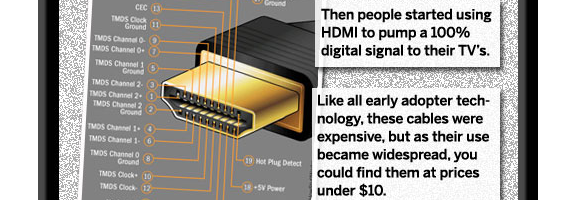 If you haven’t already heard, or discovered for yourself: Monster cables are a rip off — especially when it comes to the world of high definition digital cables. Salespeople at your local electronics store (and Monster itself) will do their best to convince you that, to get optimal video and audio quality out of your new hi-def system or video card, you need that top of the line, $150 6-foot hdmi cable. What most probably won’t tell you is that the store gets a much higher profit (and salespeople get more commission) on your expensive cable purchase than they do from your new LCD TV or Playstation 3. What they also won’t tell you is that you will get the exact same results from a $10-$20 HDMI cable that you will from it’s super-expensive counterpart.