
Does your blood boil when you see a company gouge its consumers? In a world with competition, that wouldn’t be such a big deal. The free market would rule, and consumers could just move on to a competitor.
That isn’t always possible, though, in a world where, for a variety of reasons, monopolies or pseudo-monopolies exist. In some situations, you have to suck it up and accept a company’s onerous terms, or not play ball at all. Here are three markets desperately in need of more competition.
1. Wired Broadband
When it comes to wired Internet access in the home, many people have only one choice. If you’re lucky, you have two choices (typically, cable and DSL). You’re blessed if you have three or more.
The biggest player in the market is Comcast. That’s a problem, since Comcast already has 25% of the U.S. television market as well (and sure to be more now that a federal appeals court has thrown out a rule preventing a cable company from controlling more than 30 percent of the U.S. market).
Why is that a problem? It is a problem because Comcast can use your lack of real choice in the broadband market to prop up what otherwise might become an outdated television business model. Do you want to get all of your video consumption over the Internet, instead of via cable television? Be careful that you don’t run into Comcast’s 250 GB bandwidth cap. That might not be a huge problem now, but it will be in the future, as we consume more and more online video and use other bandwidth-intensive apps.
And what is to stop your cable provider from throttling services that compete with its video offerings? Earlier this year, a federal appeals court ruled that the Federal Communications Commission lacked the authority to prevent Internet service providers from discriminating based on the type of content.
So, hold your breath and hope that services like Hulu continue to thrive. We won’t depress you further by pointing out that Comcast’s purchase of NBC should be approved soon, leading to speculation about the availability of that network’s programming on other platforms.
The U.S. also lags behind many other countries in Internet speed. South Korea is top dog, with speeds average 20 mbps, while the U.S average is 5.1 mbps.
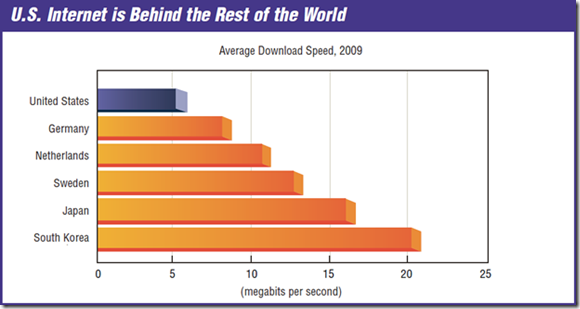
Image from Communications Workers of America.
Now that Verizon’s FIOS rollout has petered out, what incentive does a cable giant like Comcast have to invest in its infrastructure? Can we hope that DOCSIS 3.0, and the humiliation of seeing Google roll out gigabit internet, are the impetus that we need? Or is our future one of caps and metered usage?
2. Wireless Carriers
In a report earlier this year, the FCC, for the first time in years, did not find the wireless market to have “effective competition.” You already know that from personal experience, though. Can you think of another market where a handful of providers can differ so little in what they offer?
In the report, the FCC took note of the fact that carriers seemed to follow one another in jacking up early termination fees. In addition, last year the U.S. government looked into whether wireless providers were making it impossible for competitors to enter the market, by locking up exclusivity deals with handset manufacturers.
That lack of competition has allowed wireless carriers some leeway in what they allow you to do with your phone. If you have a snazzy new Samsung Android phone, for example, forget about using Skype over WiFi. Verizon and Skype have a deal in place that prevents you from using Skype over anything but 3G. The app uses your Verizon minutes, defeating part of the reason you’d use Skype in the first place. We also previously wrote about the unavailability, since changed, of certain video streaming apps over AT&T’s 3G network.
Apps that you can’t get rid of of are a big problem, too. Earlier this month, we discussed the problems facing Android users, who are faced with bloatware that they can’t remove. If you want a “pure” smartphone that can do everything that the manufacturer intended, your choices are limited.
Are you happy with your wireless provider? Or do you see a world of increased restrictions, crippled hardware, and tiered pricing plans?
3. Social Networking
When it comes to social networking, Facebook is the only game in town. Yes, there is Twitter, but Twitter really serves a different purpose than Facebook. How many of you use Twitter just for keeping up with friends? If Facebook went away, could Twitter fill the same niche?
Facebook is almost a social networking necessity, even among the tech crowd. Leo Laporte quit Facebook amid some fanfare a few months ago, only to return recently. On his radio show, he has cited his need to serve his audience (by being familiar with a service that his listeners might use), but also has pointed out that quitting Facebook really isn’t an option when all of your friends are there.
We’ve previously written about our concern over Facebook’s ever-changing, hard to understand privacy settings, and pondered what it would take to get people to leave Facebook. Many people have branded Facebook as evil, and The Social Network movie isn’t going to help this perception. Right now, though, there is nothing comparable. You either use Facebook, or leave your friends behind.
Is a monopoly a necessity when it comes to a social network like Facebook? A compelling argument can be made that the social experience would be worse, if all of your friends were spread out among different networks. Should we just grin and accept Facebook’s position of power, in the interest of a more unified social experience?
Of the three pseudo-monopolies discussed here, FB is in the most precarious position. A social network is, by its nature, a fickle place. And Facebook itself could provide the mechanism to spread the “buzz” surrounding a shinier and better social tool, if one ever emerges.
In almost all situations, monopolies and near-monopolies are bad. They stifle innovation, and customer choice. We’re seeing this in wired and wireless broadband, and with Facebook’s cavalier attitude towards consumer privacy once it gained a dominant share of the market.
I’m not a fan of government regulation, but are there other options out there, to return competiveness to these markets? Or am I getting all worked up for no reason?




3 Pseudo-Monopolies That are Killing Tech
Does your blood boil when you see a company gouge its consumers? In a world with competition, that wouldn’t be such a big deal. The free market would rule, and consumers could just move on to a competitor.
That isn’t always possible, though, in a world where, for a variety of reasons, monopolies or pseudo-monopolies exist. In some situations, you have to suck it up and accept a company’s onerous terms, or not play ball at all. Here are three markets desperately in need of more competition.
1. Wired Broadband
When it comes to wired Internet access in the home, many people have only one choice. If you’re lucky, you have two choices (typically, cable and DSL). You’re blessed if you have three or more.
The biggest player in the market is Comcast. That’s a problem, since Comcast already has 25% of the U.S. television market as well (and sure to be more now that a federal appeals court has thrown out a rule preventing a cable company from controlling more than 30 percent of the U.S. market).
Why is that a problem? It is a problem because Comcast can use your lack of real choice in the broadband market to prop up what otherwise might become an outdated television business model. Do you want to get all of your video consumption over the Internet, instead of via cable television? Be careful that you don’t run into Comcast’s 250 GB bandwidth cap. That might not be a huge problem now, but it will be in the future, as we consume more and more online video and use other bandwidth-intensive apps.
And what is to stop your cable provider from throttling services that compete with its video offerings? Earlier this year, a federal appeals court ruled that the Federal Communications Commission lacked the authority to prevent Internet service providers from discriminating based on the type of content.
So, hold your breath and hope that services like Hulu continue to thrive. We won’t depress you further by pointing out that Comcast’s purchase of NBC should be approved soon, leading to speculation about the availability of that network’s programming on other platforms.
The U.S. also lags behind many other countries in Internet speed. South Korea is top dog, with speeds average 20 mbps, while the U.S average is 5.1 mbps.
Image from Communications Workers of America.
Now that Verizon’s FIOS rollout has petered out, what incentive does a cable giant like Comcast have to invest in its infrastructure? Can we hope that DOCSIS 3.0, and the humiliation of seeing Google roll out gigabit internet, are the impetus that we need? Or is our future one of caps and metered usage?
2. Wireless Carriers
In a report earlier this year, the FCC, for the first time in years, did not find the wireless market to have “effective competition.” You already know that from personal experience, though. Can you think of another market where a handful of providers can differ so little in what they offer?
In the report, the FCC took note of the fact that carriers seemed to follow one another in jacking up early termination fees. In addition, last year the U.S. government looked into whether wireless providers were making it impossible for competitors to enter the market, by locking up exclusivity deals with handset manufacturers.
That lack of competition has allowed wireless carriers some leeway in what they allow you to do with your phone. If you have a snazzy new Samsung Android phone, for example, forget about using Skype over WiFi. Verizon and Skype have a deal in place that prevents you from using Skype over anything but 3G. The app uses your Verizon minutes, defeating part of the reason you’d use Skype in the first place. We also previously wrote about the unavailability, since changed, of certain video streaming apps over AT&T’s 3G network.
Apps that you can’t get rid of of are a big problem, too. Earlier this month, we discussed the problems facing Android users, who are faced with bloatware that they can’t remove. If you want a “pure” smartphone that can do everything that the manufacturer intended, your choices are limited.
Are you happy with your wireless provider? Or do you see a world of increased restrictions, crippled hardware, and tiered pricing plans?
3. Social Networking
When it comes to social networking, Facebook is the only game in town. Yes, there is Twitter, but Twitter really serves a different purpose than Facebook. How many of you use Twitter just for keeping up with friends? If Facebook went away, could Twitter fill the same niche?
Facebook is almost a social networking necessity, even among the tech crowd. Leo Laporte quit Facebook amid some fanfare a few months ago, only to return recently. On his radio show, he has cited his need to serve his audience (by being familiar with a service that his listeners might use), but also has pointed out that quitting Facebook really isn’t an option when all of your friends are there.
We’ve previously written about our concern over Facebook’s ever-changing, hard to understand privacy settings, and pondered what it would take to get people to leave Facebook. Many people have branded Facebook as evil, and The Social Network movie isn’t going to help this perception. Right now, though, there is nothing comparable. You either use Facebook, or leave your friends behind.
Is a monopoly a necessity when it comes to a social network like Facebook? A compelling argument can be made that the social experience would be worse, if all of your friends were spread out among different networks. Should we just grin and accept Facebook’s position of power, in the interest of a more unified social experience?
Of the three pseudo-monopolies discussed here, FB is in the most precarious position. A social network is, by its nature, a fickle place. And Facebook itself could provide the mechanism to spread the “buzz” surrounding a shinier and better social tool, if one ever emerges.
In almost all situations, monopolies and near-monopolies are bad. They stifle innovation, and customer choice. We’re seeing this in wired and wireless broadband, and with Facebook’s cavalier attitude towards consumer privacy once it gained a dominant share of the market.
I’m not a fan of government regulation, but are there other options out there, to return competiveness to these markets? Or am I getting all worked up for no reason?