Today, 40Tech is pleased to present you with a guest post from Jared Scott.
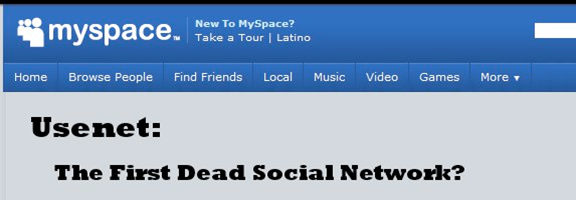
Long before you ever created your first MySpace page or added your grandma as a friend on Facebook, two guys in North Carolina were looking for a new way to share local announcements. The year was 1979, and Tom Truscott and Jim Ellis of Duke University established a link to the nearby University of North Carolina and Usenet was born.
Early the next year, Usenet was connected to ARPANET through UC Berkeley and the community quickly flourished.
Before online discussion forums, email or instant messaging, Usenet was the original social network.
In many ways, Usenet was the Wild West of the Internet. No subject was too far out there and “Newsgroups” for just about every topic imaginable were created. Spirited discussions between professionals and amateurs would play out over days, weeks or months.
Usenet is the place where Linus Torvalds’ announced Linux, Tim Berners-Lee announced the World Wide Web, and where the first “Make Money Fast” post was placed.
And most movie buffs don’t know that The Internet Movie Database, better known as IMDb, even began on Usenet in 1990.
With the emergence of the World Wide Web, many people began calling for the death of Usenet. In fact, I just read an article on TheNextWeb.com this past week referring to Usenet as Long Dead & Buried.
This couldn’t be further from the truth.
While no longer commanding the spotlight it once shined under, Usenet has been quietly thriving for years. As major Universities and Internet Service Providers abandoned their Usenet servers, private enterprise stepped in to pick up the slack.
No longer constrained by the limited budgets of academic institutions and armed with capital from paying customers, competing Usenet providers have been steadily improving the product and providing previously unthinkable levels of service.
Today, it is not uncommon for a Usenet service provider to offer one or all of the following:
- Uncapped Download Speeds. By harnessing the full speed of your Internet connection, downloads can take a fraction of the time they do with other technologies.
- Privacy & Security. Secure Sockets Layer (SSL) server connections provide an encrypted link between your computer and the server keeping prying eyes out.
- Huge Data Archives. Retention of data may be the biggest improvement of all. Almost nothing gets deleted from Usenet these days.
Now well into its 30’s, Usenet has continued to develop, evolve and mature. As one of the pillars of the Internet, Usenet has a long and robust history. And as a system built on openness and mutual benefit, Usenet is well positioned to last another 30 years.
If you’ve never used Usenet or just haven’t used it in a while, take a look. You’ll be surprised at what you find.
Jared Scott is a blogger and Internet entrepreneur who spends the vast majority of his waking hours connected to the Internet. He’s currently the Manager of Public Outreach for Binverse.com. You can follow his updates on Facebook.



![Review of GTD in Springpad & Which GTD Solution Nina Chose [Reader Workflow] | 40Tech](https://www.40tech.com/wp-content/uploads/2011/05/image12.png "Review of GTD in Springpad & Which GTD Solution Nena Chose [Reader Workflow] | 40Tech")
3 Reasons the IT Department (Still) Hates Your iPhone
Today, 40Tech is pleased to present you with a guest post by Jaelithe.
Everyone you know has one—everyone except for you. The mere mention of the shiny rectangle has your IT guy cussing under his breath. One look at the interface of this phone and it’s obvious it was designed for the consumer but that doesn’t mean it can’t do the heavy-lifting too. So what has your IT department so worked up?
Sensitive Corporate Data
In 2007 the iPhone stomped onto the cellular scene with huge technical advances and major curb appeal but it lacked some critical security features for IT departments to jump on the bandwagon. At first, the iPhone didn’t support the encryption of user data and didn’t have a solution to remotely wipe data clean in the event the phone was lost or stolen. Enterprise fraud management is a huge IT concern and becomes ever bigger if your IT department has to be concerned with you and the guy you left your iPhone next to on the bus. In addition, many IT departments achieve corporate goals with third-party applications and office suites (the iPhone wasn’t supporting them yet). Apple quickly responded, adding support for third-party apps and the ability to interact with Exchange servers. The memory of the first iPhone’s limited capabilities echoes in the minds of IT professionals everywhere—it could take a while for them to shake off the stigma.
Corporate Customization
Your company doesn’t want to pay for you to take photos in the bathroom of your abs (or other ridiculousness). The iPhone has a myriad of fun, snazzy features but companies don’t want to pay for you to take pictures for Facebook, play Angry Birds, or watch YouTube videos featuring cats jumping out of boxes. It’s critical to IT departments that they’re able to customize the features and define settings on the device in order to effectively manage compliance with the company’s acceptable-use policy. Apple is now delivering solutions to administrators.
Business Apps
In 2007 there were fewer apps that applied to serious business folks but now there’s a never-ending myriad of apps available specifically engineered to support business objectives. As Apple provides more and more solutions, it will be difficult for IT departments to hold their stance for long.
Does your IT department still hate the iPhone, or have they come around? How do they feel about Android?
Jaelithe is a freelance writer interested in all things tech. Jaelithe and her iPhone Irene live a very happy life together filled with technology and productivity. You can usually find Jaelithe writing about enterprise fraud prevention for Attachmate, and the ways that gadgets can enhance everyday life.